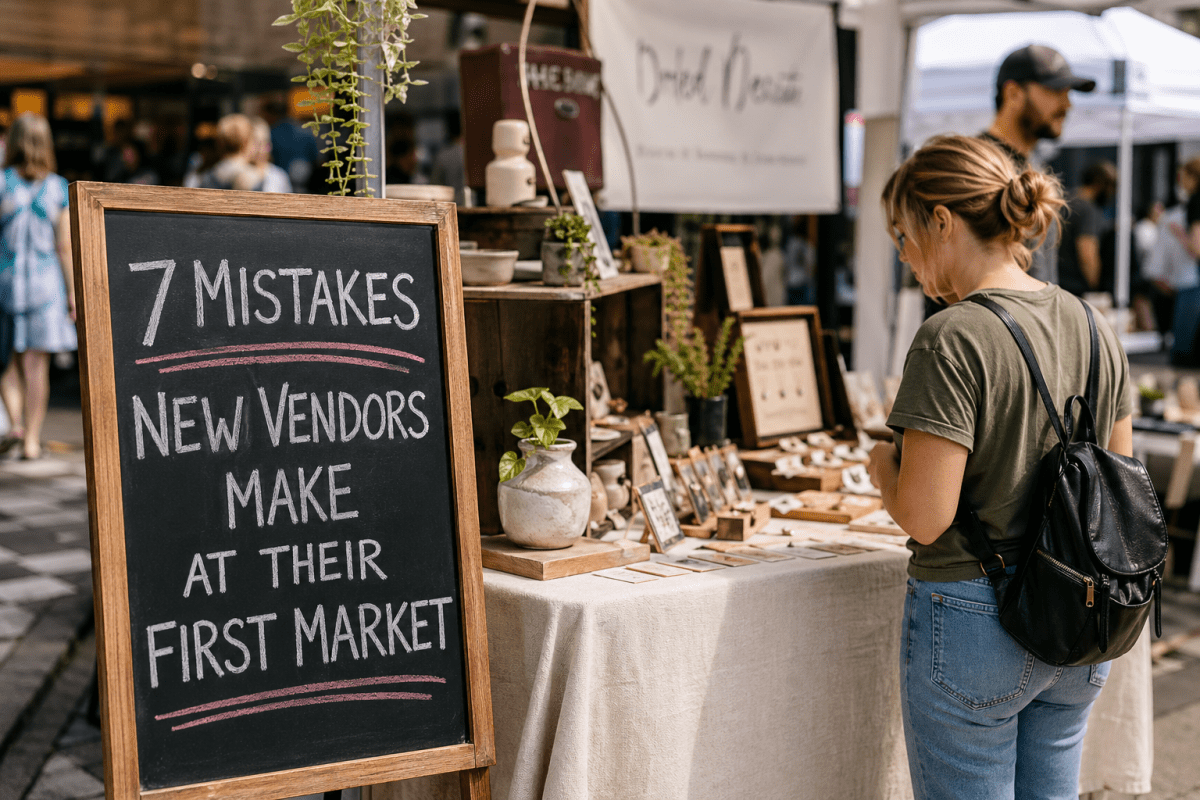
The first vendor event is exciting, nerve-wracking, and almost always a learning experience. Most vendors walk away from their first market with a list of things they'd do differently next time — and that list tends to look remarkably similar from vendor to vendor.
The mistakes new vendors make aren't about having bad products or lacking talent. They're about not knowing the unwritten rules of selling at live events — the things experienced vendors figured out over years of trial and error. Getting a head start on those lessons can mean the difference between a profitable first market and a discouraging one.
Here are seven of the most common mistakes new vendors make and how to avoid them.
1. Choosing the Wrong Event
Not every market is the right fit for every vendor. A handmade jewelry maker selling $80 earrings will struggle at a budget-focused flea market where shoppers expect everything under $10. A produce vendor with a small seasonal harvest won't fill a 10x20 booth at a large craft fair surrounded by artisan furniture makers.
New vendors often apply to the first event they find without considering whether the audience matches their product, price point, and brand. The result is a long day with very few sales and the false conclusion that "markets don't work for me."
Before applying to any event, research the market's audience. Visit as a shopper first if possible. Look at what other vendors sell there and what price points seem to move. Read reviews from past vendors if available. Ask in vendor communities whether the event is a good fit for your category.
Platforms like Local Market list vendor categories and event details upfront, which makes it easier to evaluate whether an event matches your products before you apply. Taking 15 minutes to research the event can save an entire wasted weekend.
2. Underpricing Products
New vendors almost always price too low. The reasoning feels logical — lower prices mean more sales, and more sales mean more money. But at live events, the math works differently than it does online.
Shoppers at farmers markets, craft fairs, and makers markets are specifically there to support small businesses and buy things they can't find at big box stores. They expect handmade and artisan products to cost more than mass-produced alternatives. They're not comparison shopping on Amazon while standing at a booth — they're buying based on quality, story, and connection.
Pricing too low actually hurts sales in several ways. It signals lower quality. It attracts bargain hunters who aren't the target customer. It eats into margins so heavily that a vendor can sell out and still lose money after accounting for booth fees, supplies, travel, and time. And it makes it nearly impossible to raise prices later without alienating the customer base that was attracted by the low prices.
The better approach is to price for profitability from the start. Calculate the true cost of each product — materials, labor at a fair hourly rate, packaging, overhead — and add a margin that makes the business sustainable. If the price feels high, invest in presentation and storytelling that justifies it rather than cutting the price to a level that doesn't sustain the business.
3. Neglecting the Booth Setup
At a vendor event, the booth is the storefront. Shoppers make a decision about whether to stop at a booth within about three seconds based on how it looks from a distance. A cluttered table with products scattered across a plain white tablecloth sends a very different signal than a well-designed display with clear signage, varying heights, and intentional visual flow.
New vendors tend to underinvest in their booth setup because they're focused on the products themselves. The products matter, but presentation determines whether anyone stops long enough to see them.
The basics that make a meaningful difference include a quality tablecloth or display surface that matches the brand, signage with the business name visible from at least 15 feet away, product displays at multiple heights (risers, shelves, or stands create visual interest), clear pricing on every item so shoppers don't have to ask, and a cohesive color palette or aesthetic that ties everything together.
Spending $50 to $100 on display materials before the first market is one of the highest-return investments a new vendor can make. A beautiful setup doesn't just attract shoppers — it justifies higher prices and makes the vendor look established even if it's their first event.
4. Bringing Too Much or Too Little Inventory
Inventory planning for a first market is a genuine challenge because there's no historical data to work from. Most new vendors err in one of two directions: they bring so much inventory that the booth feels like a warehouse, or they bring so little that they sell out by noon and miss the afternoon rush.
Bringing too much creates a cluttered, overwhelming display that makes it harder for shoppers to focus on individual products. It also means hauling more products to and from the event, which adds to setup and breakdown time. Worse, unsold inventory at the end of the day can feel demoralizing even if the vendor actually had strong sales.
Bringing too little means leaving money on the table. Selling out sounds like a success, but if it happens at 11 AM during a market that runs until 4 PM, the vendor missed five hours of potential sales and wasted the booth fee for those hours.
A reasonable starting point for a first market is to bring enough inventory to generate roughly three to four times the booth fee in potential sales at retail prices. For a $150 booth fee, that means bringing $450 to $600 worth of products. This provides a buffer for the reality that not everything will sell while ensuring there's enough to make the day profitable.
After the first market, the real data starts flowing. Track exactly what sold, what didn't, what time of day sales peaked, and which products attracted the most attention. This data becomes the foundation for smarter inventory planning at every future event.
5. Not Engaging With Shoppers
The single biggest factor in whether a vendor has a good sales day is how they interact with shoppers. This is where live events differ most dramatically from online sales — the vendor is the brand in person, and the human connection drives purchasing decisions.
New vendors commonly make one of two engagement mistakes. The first is being too passive — sitting behind the table, looking at a phone, waiting for shoppers to approach and ask questions. This signals disinterest and makes shoppers feel like they're intruding by looking at products.
The second is being too aggressive — jumping on every person who glances at the booth with a sales pitch. This creates pressure that drives shoppers away, especially at markets where the atmosphere is relaxed and browsing is expected.
The sweet spot is warm, low-pressure engagement. Stand up. Make eye contact and smile. Offer a simple greeting like "let me know if you have any questions about anything." If a shopper picks up a product, share a brief story about it — how it's made, what inspired it, what makes it different. Let the conversation develop naturally rather than pushing toward a transaction.
Vendors who genuinely enjoy talking about their craft and connecting with people consistently outsell vendors with better products but worse engagement. At a live event, the experience of buying is as important as the product itself.
6. Ignoring the Business Side
Many new vendors treat their first market as a casual experiment rather than a business activity. They don't track expenses, don't calculate profit margins, don't collect customer emails, don't bring business cards, and don't have a plan for turning one-time buyers into repeat customers.
The vendors who build sustainable businesses from live events treat every market as a data-gathering and relationship-building opportunity. They track every dollar spent and earned. They bring a sign-up sheet or tablet for an email list. They hand out business cards or flyers with their website and social media. They follow up with customers after the event. They photograph their booth for social media content.
The most overlooked business essential at a first market is accepting card payments. Studies consistently show that vendors who accept credit and debit cards make significantly more in sales than cash-only vendors. Shoppers increasingly don't carry cash, and a "cash only" sign sends away customers who are ready to buy. A simple mobile card reader costs almost nothing and pays for itself within the first hour of the first market.
Building relationships with event organizers is another business move that pays dividends. Introducing yourself to the organizer, being professional and easy to work with, and following up after the event with a thank-you note puts the vendor at the top of the list for future events. Organizers talk to each other, and a vendor who's known for being professional, reliable, and pleasant to work with gets recommended to other markets. Building a vendor profile on Local Market makes it easier for organizers to find and vet vendors who want to attend their events.
7. Applying to Unverified Events
This is the mistake that can cost a new vendor the most money with zero return. In the rush to book their first market, new vendors sometimes apply to events they haven't fully researched — and some of those events aren't real.
Vendor event scams have grown significantly over the past few years. Scammers create fake Facebook event pages using real markets' names and flyers, set up Google Form applications, collect booth fees through irreversible payment methods like Zelle and Venmo, and disappear. The Michigan Attorney General issued a public warning about this exact pattern in March 2026. Vendors have shown up to venues expecting a market and found nothing there.
For a deeper dive into how these scams work and how to spot them, read our guide on how to verify a vendor event before you apply. The short version is this: verify the organizer independently, confirm the venue with a phone call, be suspicious of Google Form applications that aren't linked from an official website, and never send booth fees through peer-to-peer payment apps to someone you haven't verified.
The safest approach is to apply through platforms that verify events before listing them. Local Market verifies every event organizer's identity, venue, and event details before vendors can apply. Every event on the platform carries a verified badge, which means vendors can apply with confidence that the event is real, the organizer is who they say they are, and the venue is confirmed.
For a new vendor who doesn't yet have a network of trusted organizers and fellow vendors to rely on, this kind of verification is especially valuable. Building that network takes time. In the meantime, using a verified platform eliminates the riskiest part of being new.
The First Market Is Just the Beginning
Every experienced vendor remembers their first market. Most will tell stories about the mistakes they made, what they learned, and how different their approach is now compared to when they started. The mistakes listed here aren't failures — they're the tuition cost of learning a business that has no formal training program.
The vendors who succeed long-term are the ones who treat each market as a learning opportunity, track their results, adjust their approach, and keep showing up. The first market is never the best market. But it's the one that starts the journey.
The most important thing a new vendor can do is set themselves up to learn as much as possible from day one. Choose the right event, price for profitability, invest in presentation, plan inventory thoughtfully, engage with shoppers authentically, run the business side properly, and make sure the event is real before sending any money.
Do those seven things and the first market won't just be a learning experience — it'll be a profitable one.
Ready to find your first verified vendor event? Browse verified events on Local Market and apply with confidence. Every event is verified, every organizer is vetted, and every application is secure.