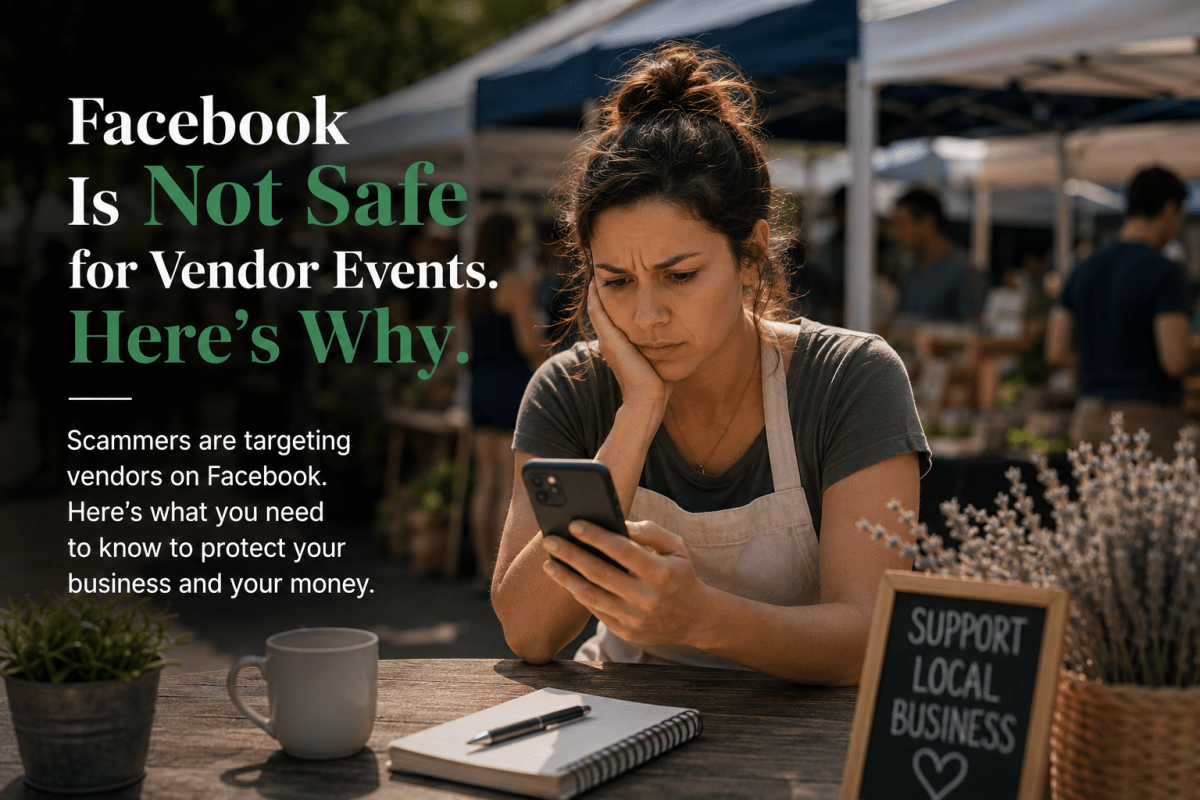
Every week, small business vendors across the country lose money to scammers on Facebook. The scams are getting more sophisticated, more frequent, and harder to spot. And Facebook has no way to stop them.
The pattern is well-documented at this point. Scammers steal real event flyers, change the details, and post them as their own. They set up fake Google Forms to collect vendor applications. They impersonate real organizers by name in emails and texts. They collect booth fees through Zelle, Venmo, Chime, and Cash App. And now they've found an even simpler method — they skip the fake event page entirely and just comment on real organizers' Facebook posts, pretending to offer booth space and redirecting vendors to pay them directly.
That last method is the most alarming because it means even when an organizer does everything right, their vendors can still get scammed. An organizer can post a flyer that clearly states who the only point of contact is and that payments are only accepted through their official website. It doesn't matter. A scammer comments "message me to book a spot," a vendor who didn't read the full post messages them instead, and the money is gone.
This isn't a hypothetical. It's happening right now, across the country, at an accelerating rate. The Michigan Attorney General issued a public warning about vendor event scams on Facebook in March 2026. The Better Business Bureau has documented cases of scammers impersonating real arts centers and markets to collect booth fees. The FTC reported nearly $3 billion in imposter scam losses last year alone.
The Scam Goes Far Beyond Booth Fees
What starts with a booth fee rarely ends there. Once a scammer has a vendor on the hook, the upsells begin — and this is where the financial damage multiplies.
Scammers are charging vendors for fake liability insurance policies. Most markets require vendors to carry event-day liability insurance, and scammers exploit that expectation by offering coverage as part of the application process. The vendor pays $50 to $200 for a policy that doesn't exist, from an insurer that isn't real. When the vendor attends a legitimate event later believing they're covered, they're not. One liability claim and they discover their insurance was part of the scam.
Scammers are charging for tent and table rentals that never arrive. Many events offer equipment rentals as part of the vendor package, and scammers mimic this by adding rental fees to their fake invoices. A vendor pays $75 for a tent and $40 for a table, shows up to the venue — if the event exists at all — and there's nothing waiting for them.
They charge for premium booth placement. For electricity access. For parking passes. For branded t-shirts the vendor is supposedly required to wear. Each charge is small enough to seem reasonable and large enough to add up. A vendor who initially paid $130 for a booth fee can end up losing $300 to $500 by the time all the upsells are tallied.
Multiply that across dozens of vendors per fake event, across hundreds of fake events per year, and millions of dollars are being stolen from small business vendors annually. Money taken directly from people who make handmade products, grow food, and build their businesses one market at a time.
Why Facebook Can't Fix This
Facebook was built for social networking. It was not built to be a vendor event management platform, a payment processor, or a verification service. When organizers use Facebook to post events and manage vendor applications, they're using a tool that has none of the safeguards this type of transaction requires.
Anyone can comment on a public event post. Anyone can create a Facebook profile that looks like a legitimate business. Anyone can send a direct message claiming to represent an event. There is no identity verification for event organizers, no badge system for legitimate markets, no payment protection for booth fees, and no way for vendors to confirm that the person they're communicating with is actually affiliated with the event.
Facebook removed over 700 million fake accounts in a single quarter. Social media marketplace fraud has grown by more than 50 percent year over year. The platform has acknowledged through its Brand Rights Protection updates that business impersonation is a significant problem. But the fundamental architecture of Facebook makes vendor event fraud nearly impossible to prevent at the platform level.
The comments section is an open door. The messaging system is unverified. The event pages have no organizer authentication. No amount of vigilance by individual organizers can fix a structural problem with the platform itself.
What a Verified Platform Looks Like
The vendor event industry needs infrastructure that was actually designed for vendor events — not a social media platform being used for something it was never built to handle.
That means a platform where organizers are verified before they can list an event. Where vendor applications go through a secure system, not through open Facebook comments or direct messages from unverified accounts. Where payments have a paper trail and don't flow through irreversible peer-to-peer apps to unverified recipients. Where every event has been confirmed — real organizer, real venue, real dates — before a single vendor is asked to pay anything.
This is what Local Market was built to provide. Every organizer on the platform goes through a verification process before their event is listed. Vendors browse verified events and apply through the platform, not through social media. The application process is controlled, the communication is documented, and scammers cannot insert themselves into the process because they cannot pass verification.
When a vendor finds an event on Local Market, they know the organizer has been vetted. They know the venue is confirmed. They know the event is real. They don't need to Google the organizer, call the venue, ask around in Facebook groups, or hope for the best. The verification has already been done.
For organizers, the platform provides the same protection in reverse. When an organizer lists their event on Local Market instead of relying solely on Facebook, their event can't be hijacked by scammers in the comments section. Their name can't be impersonated by someone messaging their vendors. Their flyer can't be copied and attached to a fake Google Form. The verified listing is the single source of truth, and vendors know to trust it.
What Organizers Should Do Right Now
If Facebook is your primary tool for recruiting vendors and managing applications, your vendors are at risk. Not because of anything you're doing wrong — because of how the platform works.
Move your vendor applications off Facebook. Use a platform that verifies organizer identities and secures the application process. Local Market does this for free for organizers — listing an event takes about 10 minutes and your vendors can apply with confidence that they're dealing with the real you.
If you continue posting events on Facebook for marketing purposes, monitor your comments aggressively. Delete any comment from someone claiming to offer booth space or accept payments. Report those accounts immediately. Include a clear, prominent statement in every post that applications are only accepted through your official platform — never through comments, messages, or third-party links.
Talk to your vendors directly. Send an email to your vendor list warning them about the scam patterns. Tell them exactly how your application process works and how payments are collected. Make sure they know that if someone contacts them through Facebook claiming to represent your event and asking for payment, it's a scam.
What Vendors Should Do Right Now
Never pay for a booth, insurance, equipment rental, or anything else based on a Facebook comment or direct message. Even if the comment appears on a legitimate event post, it may not be from the organizer.
Before sending any payment, verify the organizer's identity through their official website or verified platform listing. If the event is listed on Local Market, you can confirm in seconds that the organizer is verified and the event is real.
Be cautious of anyone who upsells you on insurance, tent rentals, t-shirts, or premium placement after you've already paid a booth fee. Legitimate organizers are transparent about their full pricing upfront. Scammers layer charges because each additional payment extracts more money before the vendor realizes something is wrong.
If you're asked to send a screenshot of your payment, walk away. A legitimate organizer receives the money directly and doesn't need proof from you. Payment screenshot requests are one of the most reliable indicators of a scam.
Use the Local Market scam checker to evaluate any event you're unsure about. Answer six quick questions and get a risk assessment based on warning signs commonly associated with vendor fraud.
The Vendor Event Industry Deserves Better
Farmers markets, craft fairs, and makers markets are the backbone of local economies across America. They create income for small business owners, bring communities together, and support local agriculture and artisanship. The organizers who run these events pour their time and passion into building something meaningful for their communities.
Those organizers and vendors deserve a platform that was built to protect them — not one that leaves the door open for anyone with a fake profile and a Zelle account to steal from them.
Facebook isn't going to build it. Zelle isn't going to build it. The solution has to come from within the vendor event community itself. That's why Local Market exists.
The transition from Facebook to verified platforms isn't going to happen overnight. But every organizer who moves their applications to a verified platform, and every vendor who chooses to apply through verified channels, makes the ecosystem safer for everyone. The scammers win when the industry stays on platforms that can't protect it. They lose when organizers and vendors move to ones that can.
Are you an event organizer? List your event on Local Market and give your vendors a verified, secure way to find and apply to your event. Free to list, takes 10 minutes.
Are you a vendor? Browse verified events on Local Market and apply with confidence. Every event is vetted, every organizer is verified.
Have you been scammed by a fake vendor event? We want to hear your story. Documenting these scams helps protect other vendors and builds the case for industry-wide change. Reach out to us at localmarketplace.ai.