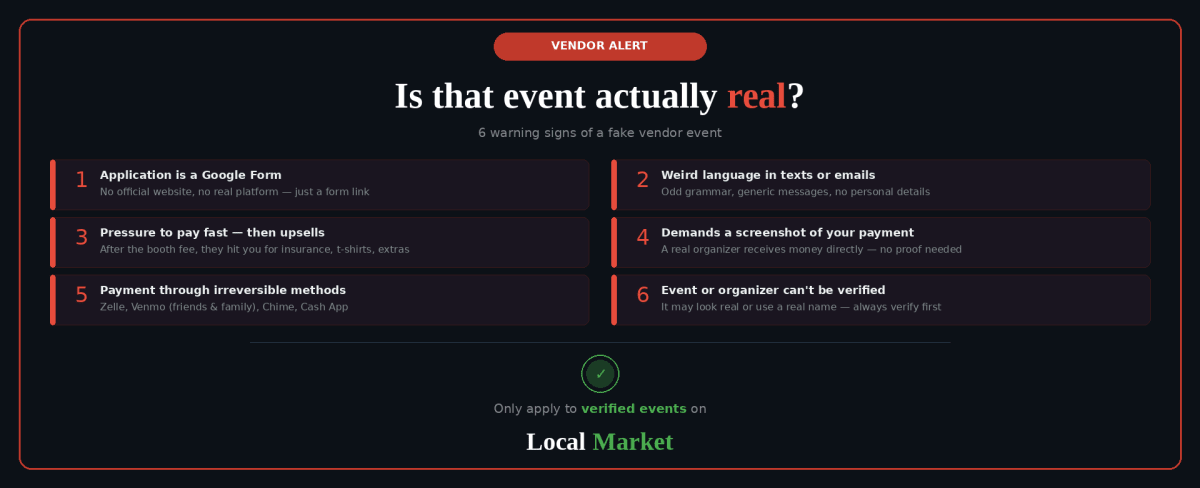
Two weeks ago, Michigan Attorney General Dana Nessel issued an urgent warning to vendors across the state. Scammers had created fake Facebook event pages impersonating popular art fairs and festivals — including Plymouth's well-known Art in the Park. The fake pages looked real. The booth fees looked normal. Vendors were told to reserve space via text and send payment through Zelle.
The money went directly to the scammers. The vendors got nothing.
This wasn't an isolated case. It wasn't even a new tactic. It's happening across the country, and it's happening to markets like yours.
If you run a farmers market, makers market, or craft fair, you need to understand something: scammers are actively using your market's name, your photos, and your reputation to steal from the vendors who trust you. And most organizers don't find out until the damage is already done.
How the Scam Works
The playbook is almost always the same.
A scammer creates a Facebook event page using the name of a real, established market. They pull photos from your actual social media accounts or website. They copy your event description, sometimes word for word. They set up the page to look like it's officially connected to your organization.
Then they start collecting booth fees.
Vendors — especially newer ones who are actively searching for events to sell at — find the page through Facebook's event search. Everything looks legitimate because it's built on your real market's identity. The scammer communicates through Facebook Messenger, text, or email, provides a Zelle or Venmo handle for payment, and disappears once enough money has been collected.
The vendors lose their money. And your market loses something harder to get back: trust.
This Is Not a Small Problem
In January 2026, the St. Albert and District Chamber of Commerce in Alberta sounded the alarm on a scam targeting vendors for their 2026 Farmers' Market. Scammers sent emails impersonating the chamber's actual farmers market manager by name, directing vendors to a fake application link designed to collect fees and personal information.
In March 2026, Michigan's Attorney General called out fake Facebook pages spoofing real festivals and art fairs statewide, collecting booth fees through Zelle before vanishing.
According to industry reporting, one common version of this scam involves creating a fake "Holiday Market" using photos from a real market's previous year, collecting $150 or more from 50-plus vendors before disappearing — a single-event loss of $7,500 or more for the vendor community.
And those are just the cases that made the news. For every scam that gets reported, there are dozens that don't. Vendors who lose $150 often feel too embarrassed to come forward. They just quietly stop trusting the market ecosystem altogether.
Meanwhile, Facebook's own fraud numbers tell a broader story. Social media marketplace fraud grew 54% in the past year. The platform removed 700 million fake accounts in a single quarter. For scammers, creating a fake event page takes five minutes and costs nothing.
Why Market Organizers Should Care
You might be thinking: this is a vendor problem, not my problem. My real event is fine.
Here's why it's absolutely your problem.
Your reputation is being used without your permission. When a vendor gets scammed by a page using your market's name, they don't blame some anonymous scammer. They blame your market. They tell other vendors. They post about it. Your name gets attached to the word "scam" in Facebook comments and vendor forums — and that association is incredibly hard to undo.
You may lose vendors to the confusion. If vendors aren't sure which page is real and which is fake, some will simply avoid your event altogether. Why risk $150 on something that might be a scam? This is especially true for first-time vendors who don't already have a relationship with you.
Your community loses trust in the entire system. Every successful scam makes it harder for all legitimate markets to attract vendors. The vendor who got scammed once doesn't just avoid the fake market — they become suspicious of every new market they encounter. The entire ecosystem suffers.
It can create legal and PR headaches. If scammers are collecting money under your market's name, you may need to issue public warnings, deal with angry vendors who think you were involved, and potentially work with law enforcement to clear your name.
What You Can Do Right Now
The good news is that you don't have to wait for Facebook to fix this. There are practical steps you can take today to protect your market and your vendors.
Claim and control your online presence
If your market doesn't have an official, verified Facebook page with a complete profile, event history, and active posting, you're leaving the door open for impersonators. Make sure your official page is clearly established, has consistent branding, and posts regularly. Link it from your website. Tell your vendors which page is the real one.
Search for your market's name on Facebook periodically. If you find fake pages or events using your name, report them immediately through Facebook's impersonation reporting tool. Ask your vendors and community to report them too — volume of reports speeds up takedowns.
Communicate directly with your vendors
Don't rely on Facebook alone to reach your vendor community. Build a direct email list. When your application opens, announce it through your own channels first. Make it clear that you will never ask for payment through Zelle, Venmo, or text message.
When scams do pop up using your name, get ahead of it fast. Send an email blast. Post a warning on your real page. The St. Albert Chamber of Commerce did this effectively — the moment they discovered the fake email campaign, they contacted local media and warned vendors publicly. Fast action limits the damage.
Educate your vendors on what to look for
Share these red flags with your vendor community:
- Event pages that are brand new with few followers or no posting history
- Communication that happens only through text or Messenger (not official email)
- Payment demanded through Zelle, Venmo, Cash App, or gift cards
- Pressure to pay immediately with language like "only 2 spots left"
- Inability to provide a specific street address, permit details, or organizer credentials
- No website outside of Facebook to verify the event
Legitimate markets don't pressure vendors to pay instantly through peer-to-peer payment apps. If it feels rushed, it probably isn't real.
Give vendors a trustworthy way to verify your event
This is where the real solution lies. The fundamental problem isn't that scammers exist — it's that vendors have no reliable way to tell the difference between a real event and a fake one. Facebook doesn't verify event organizers. There's no badge, no credential, no standard.
That's the gap that needs to be filled.
When a vendor finds your event listing, they should be able to verify in seconds that you're a real organizer with a real event at a real venue. Not by Googling and hoping. Not by asking around in Facebook groups. Through an actual verification system that confirms your identity and your event's legitimacy.
A Better Way Forward
This is why we built Local Market.
Local Market is a platform where event organizers — we call them Market Masters — can list their farmers markets, makers markets, craft fairs, and vendor events. But unlike Facebook or Craigslist, every event on our platform goes through a verification process before vendors can apply. When you list your event on Local Market, we verify your identity, your venue, and your event details. Once verified, your listing carries a verified badge that tells vendors: this is real. This organizer is who they say they are. You can apply with confidence. For vendors, this means a scam-free space to find events.
No fake pages. No vanishing organizers. No Zelle payments to strangers. For you as an organizer, it means something just as valuable. It means better vendor applications from people who take their business seriously — because the kind of vendor who seeks out a verified platform is the kind of vendor who shows up on time, stays until close, and represents your market well. It also means your market's reputation is protected. When your event is verified on Local Market, scammers can't create a fake version. Your real listing is the only one, and vendors know it.
Your Market's Name Is Worth Protecting
You've spent years — maybe decades — building your market's reputation. You've cultivated vendor relationships, grown your shopper community, and established your event as something your town looks forward to.
A scammer can undermine that in an afternoon with a fake Facebook page and a Zelle account.
You don't have to let that happen.
Listing your event on Local Market is free for early organizers, takes about ten minutes, and gives your vendors a verified, trustworthy place to find and apply to your event. No contracts. No fees. Just a safer way to connect with the vendors who make your market great.
Ready to protect your market? Become a Market Master on Local Market →
Have you encountered scammers impersonating your market? We'd love to hear your story. Reach out to us — and if you know other market organizers dealing with this problem, please share this article with them.