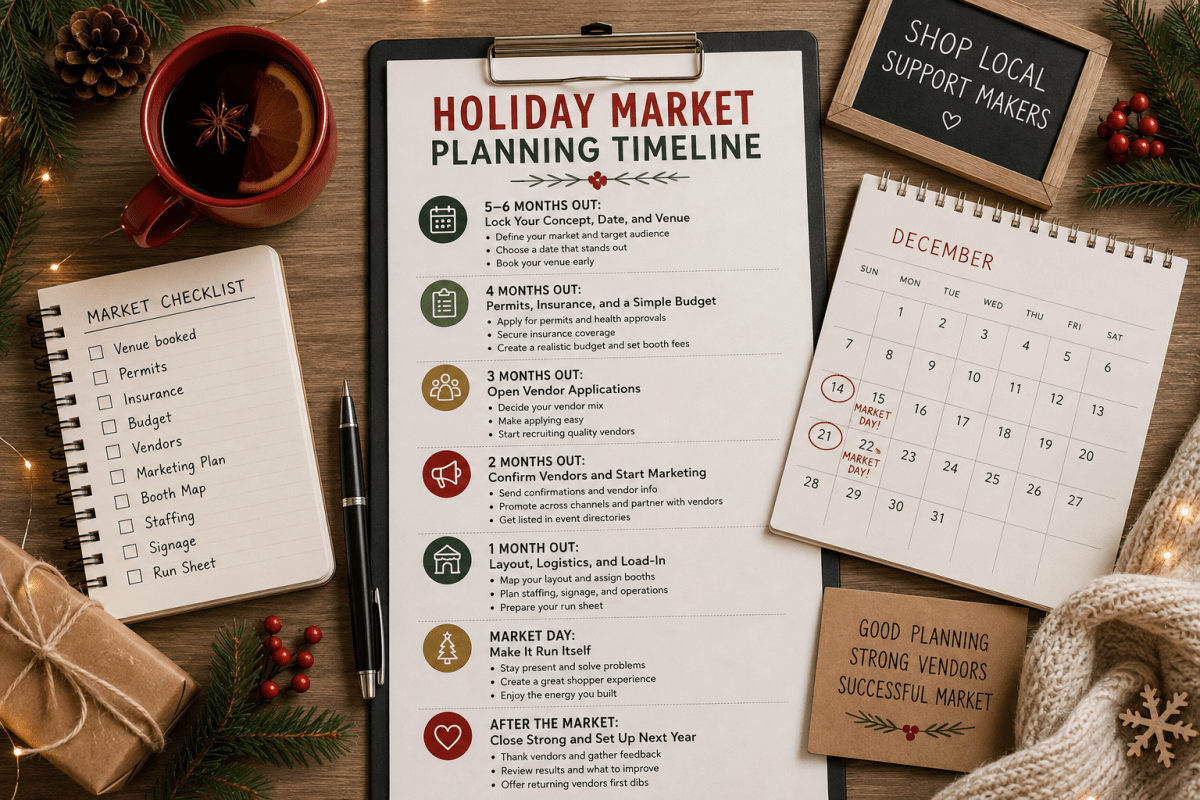
Holiday markets feel spontaneous when you walk through them, string lights, cider, a crowd in scarves. But the ones that feel effortless were planned months in advance. The best venues get booked by summer, the strongest vendors commit early, and permits don't move on your schedule.
If you're thinking about running a holiday or winter market this year, now is the time to start. Here's a realistic, month-by-month timeline, from first idea to teardown, plus the small stuff that quietly makes or breaks the day.
5–6 Months Out: Lock Your Concept, Date, and Venue
Before anything else, get clear on what kind of market this is. A curated artisan gift market, a food-and-maker night market, a church or nonprofit craft fair, and a downtown holiday stroll all attract different vendors and shoppers. A tight identity makes every later decision easier.
Then nail down the two things everything else depends on:
- Date: Weekends from mid-November through mid-December are prime, but they're also crowded. Check your town's event calendar so you're not competing with the tree lighting or a bigger market down the road. A weeknight "holiday night market" can stand out.
- Venue: Indoor or covered space is worth paying for in December — weather will otherwise dictate your turnout. Look for parking, restrooms, heat or power, and a load-in area. Get the date in writing early; holiday-season venues fill first.
4 Months Out: Permits, Insurance, and a Simple Budget
This is the unglamorous month, and it's the one people skip and regret.
- Permits: Most towns treat markets as a temporary use or special event — you'll likely need a permit from the town, and a health-department sign-off if you'll have food vendors. Budget 60–90 days, because municipal timelines don't rush.
- Insurance: Most venues require a general liability certificate ($1M–$2M is typical). A vendor agreement that passes liability to individual vendors protects you too.
- Budget: List your costs (venue, insurance, permits, marketing, signage, staffing) and back into the booth fee you'll need to charge. If you're not sure where to land, our guide on how to price booth fees walks through the math.
3 Months Out: Open Vendor Applications
Good vendors plan their holiday season early — if you open applications late, you're recruiting from whoever's left. Open now.
Decide your vendor mix before you approve anyone. A gift market that's 80% jewelry will disappoint shoppers; balance makers, food, and specialty goods so every booth feels like a new discovery. Aim for variety in price points too — impulse-buy stocking stuffers and centerpiece gifts.
Make applying easy. If vendors have to email you a form and mail a check, you'll spend the fall chasing paperwork. A simple online application where vendors submit their info, what they sell, and their booth preference — then pay online once approved — saves you dozens of hours. With Market Manager, that whole flow is free for organizers: you publish your market, vendors apply, you approve with one click, and booth fees deposit straight to your bank through Stripe. You keep the full booth fee. For more on filling your roster, see how to attract vendors to your market.
A note on trust: Scammers increasingly impersonate market organizers to collect fake booth fees over Zelle or Venmo. Vendors know this now, and it makes them cautious. Listing your event publicly with real online payments — rather than asking for cash-app transfers — signals that your market is legitimate, which is exactly what good vendors are looking for.
2 Months Out: Confirm Vendors and Start Marketing
By now your roster should be filling. Send accepted vendors a clear confirmation: date, load-in time, booth size, what's provided (tables? power?), and what they bring. Ambiguity here creates chaos on market day.
Start marketing in parallel:
- Get listed where shoppers already look for local events, including Local Market's market directory, so people searching your area can find you.
- Recruit your vendors as promoters — they'll each share the event with their own followings, which is your cheapest and most effective reach.
- Build a simple event page with the date, location, a few vendor highlights, and parking info. Update it as vendors confirm.
- Plan your social posts now so you're not scrambling in December. A weekly "meet a vendor" post gives you easy content and gives vendors a reason to reshare.
1 Month Out: Layout, Logistics, and Load-In
Walk the venue with a tape measure. Sketch a booth map that keeps aisles wide, puts food near power and trash, and avoids clustering similar vendors. Assign booth numbers so load-in isn't a free-for-all.
Finalize the operational details:
- Staffing: Who greets vendors, handles check-in, manages problems, and runs teardown? Even a small market needs 2–3 people who know the plan.
- Signage: Entrance signs, a printed or posted market map, and restroom/parking directions.
- Day-of run sheet: A simple timeline — setup, vendor arrival window, doors open, close, teardown, venue inspection.
- Weather and contingency: Even indoors, plan for snow affecting turnout and travel. Have a call on cancellation or a snow date decided in advance.
Market Day: Make It Run Itself
The goal on the day is to be available, not busy. If you've done the planning, you should be walking the floor, solving small problems, and greeting shoppers — not fielding "where's my booth?" for two hours.
- Open the doors on time; a line at opening builds energy.
- Keep a check-in station at load-in with booth assignments and a contact number.
- Have a shopper-experience touch or two: a market map, a photo spot, cider, or live music. These are what get people to stay, spend, and come back.
- Track what's working in real time — which corners are dead, where the crowd bunches — so next year's layout is better.
After the Market: Close Strong and Set Up Next Year
The market isn't over when the lights come down. The hour you spend afterward is what makes next year easier.
- Thank your vendors and send a short survey while it's fresh — what sold, what they'd change, would they return.
- Review the numbers: attendance, revenue, costs, and what you'd charge or spend differently.
- Capture your shopper list if you collected emails, so you can invite them back.
- Offer returning vendors first dibs on next year. Retention is far cheaper than recruiting from scratch, and a stable core roster is the foundation of a market that grows.
Ready to Plan Yours?
A great holiday market is mostly a great timeline — start early, recruit good vendors, and make the paperwork painless so you can focus on the experience. Market Manager gives you online applications, one-click approvals, and secure booth-fee collection, free for organizers — so you can spend your energy on the market, not the admin. Create your market free and start building your vendor roster today.