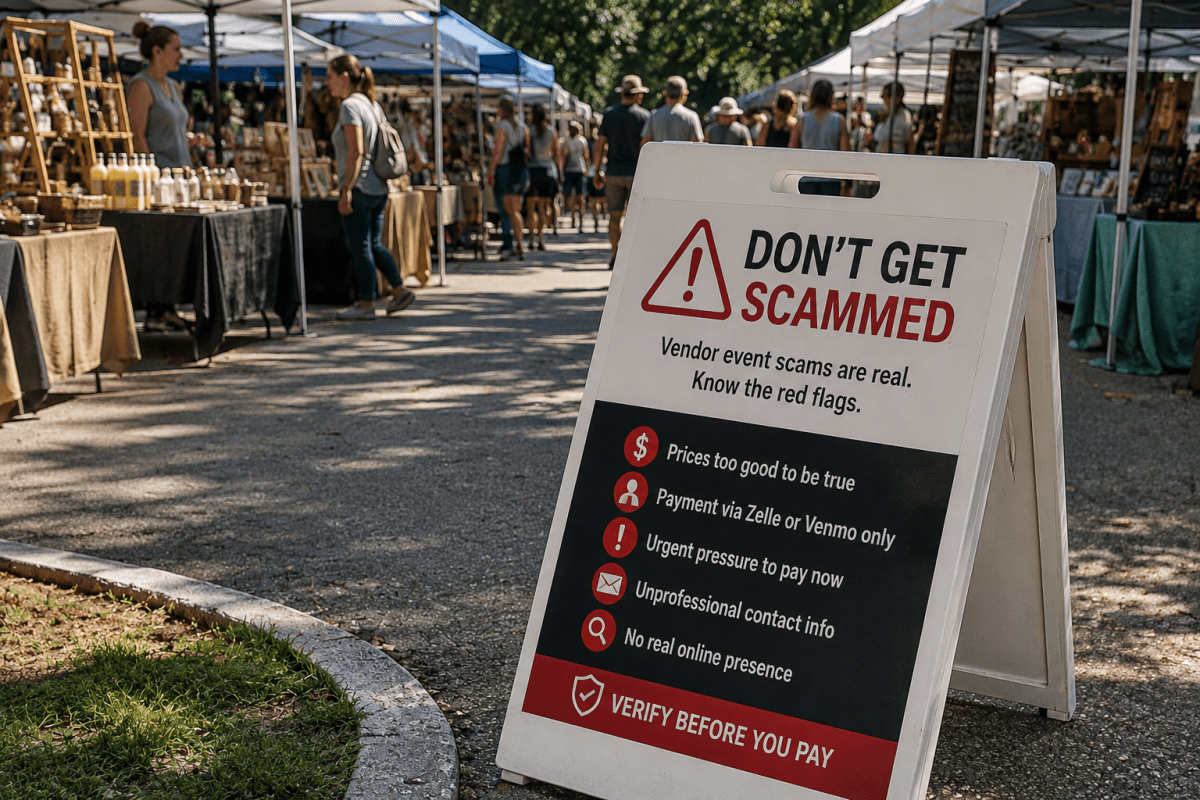
If you sell at craft fairs, farmers markets, or pop up events, you have probably seen the messages. A friendly "organizer" invites you to a market you have never heard of, offers a cheap booth, and asks you to pay fast through Venmo or Zelle. Then the event details never come, and neither does your money back.
Vendor event scams are getting more common and more convincing. The good news is that almost every one of them shares the same warning signs. Once you know what to look for, you can spot a fake event in about a minute. This guide walks you through exactly how.
How vendor event scams usually work
Most fake vendor events follow one of a few playbooks:
- The copycat event. Scammers take a real market's name, logo, and details, then build a lookalike page or send official looking application PDFs. You think you are applying to a real event because the details check out.
- The too good discount. A "manager" offers a booth well below the normal rate, then adds surprise fees and asks you to send more money to a different person.
- The vanishing organizer. You pay a booth fee through a peer to peer app, and the person simply disappears. No confirmation, no event, no refund.
These are not rare edge cases. Real vendors have lost 50 dollars, 120 dollars, and more to exactly these tactics. Insurance provider ACT recently featured Local Market in their guide on vendor event scams, which documents several real cases. Verifying events before you pay is the whole reason we built our platform.
The red flags to watch for
Before you send a single dollar, run through this list. Any one of these should make you slow down.
- Peer to peer payment only. If the organizer insists on Zelle, Venmo, Cash App, or friends and family transfers, be very careful. These payments are hard to reverse and offer almost no buyer protection.
- A price that is too good. A booth fee far below the going rate is often bait.
- Pressure and urgency. "Only two spots left" and "pay today to hold your spot" are designed to stop you from checking.
- Personal accounts only. Communication that happens entirely through a personal email address, a new social account, or private messages is a warning sign.
- A thin or brand new event page. Few followers, almost no posts, spelling errors, or a slightly altered name or logo all point to a fake.
- Fake vendor insurance. Some scammers try to sell you nonexistent event insurance through a suspicious link. Only buy coverage from trusted providers with secure checkouts.
How to verify an event before you pay
Verifying an event does not take long. Here is the simple version:
- Find the event on an official source. Look it up outside of social media, on the organizer's real website or a trusted event directory. You can browse verified events on Local Market's event directory.
- Contact the organizer directly. Use the contact details from the official site, not the ones in the message you received.
- Check the payment method. Legitimate organizers can usually take a secure payment. Extreme pressure to use only a peer to peer app is a red flag.
- Save your evidence. Keep screenshots of every message and confirmation before you pay, in case you need to dispute a charge later.
Use our free vendor scam checker
If you would rather not run through the checklist on your own, we built a free tool that does it with you. Answer a few quick questions about the event and get an instant risk score, with a clear explanation of which warning signs apply.
Try the free Vendor Scam Checker. It takes about a minute, and you do not need an account.
What to do if you already got scammed
If it already happened, you are not alone, and there are still steps worth taking:
- Document everything: messages, usernames, confirmations, and receipts.
- Contact your bank or payment provider right away to dispute the charge.
- Notify the real event organizer so they can warn other vendors.
- Report the fake page to the platform it lives on.
- File reports with your local police, the FTC, and the IC3.
Sell with confidence
Scams work by rushing you. The single best defense is to slow down and verify before you pay. Learn the red flags, confirm the event on an official source, and avoid peer to peer payments to people you cannot verify.
When you are ready to find events you can trust, browse verified markets on Local Market or check an event with our free scam checker. Selling locally should grow your business, not cost you a booth fee for an event that never existed.