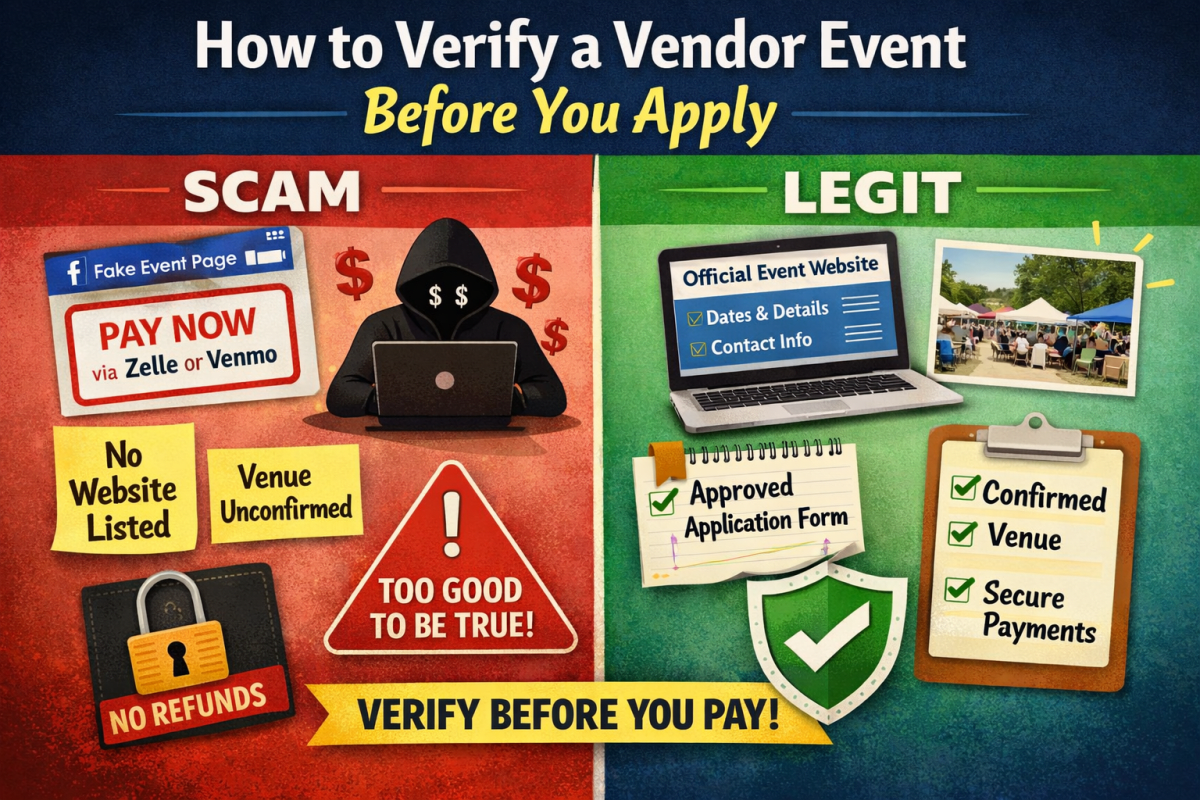
Vendor scams have become one of the fastest-growing problems in the small business community. Scammers create fake event pages, copy real market flyers, and impersonate legitimate organizers to collect booth fees from vendors who have no way of knowing the event isn't real. By the time the vendor shows up to the venue, the scammer is gone and so is the money.
The Michigan Attorney General issued a public warning about this exact pattern in March 2026, calling out fake Facebook event pages impersonating well-known art fairs and festivals. The Pocumtuck Valley Memorial Association, the St. Albert Chamber of Commerce, and dozens of other organizations have raised the same alarm. The pattern is consistent across regions: a real market gets impersonated, vendors get scammed, and the legitimate event suffers reputation damage in the process.
The good news is that verifying a vendor event before applying takes about 10 minutes and dramatically reduces the risk of getting scammed. This guide walks through exactly what to check, in what order, and what to do if anything looks off.
Why Verification Matters More Than Ever
Five years ago, finding vendor events meant word of mouth, local newspapers, or a handful of trusted directories. Today, most vendors find events through Facebook, Instagram, and other social platforms where anyone can create an event page in minutes. Facebook removed over 700 million fake accounts in a single quarter last year. Social marketplace fraud has grown by more than 50 percent year over year.
The result is that vendors are exposed to scam events at a scale that didn't exist a few years ago. The scammers have gotten more sophisticated too. They use real photos from past events, copy actual organizer names, and write professional-sounding descriptions. A casual look at a fake event page often won't reveal anything suspicious.
Verification has become a non-negotiable step before any vendor sends payment. Treating every event as potentially fraudulent until proven otherwise is the only safe approach.
Step 1: Find the Organizer's Official Website
Every legitimate established market has an official website. Not just a Facebook page — an actual website with its own domain, contact information, history, and event details. The first verification step is finding that site.
Search the market name in Google. Look for a website that appears to be the official one — usually it will be the top organic result, or it will be linked from local government pages, chamber of commerce listings, or established directories. Be cautious of sites that look new, have generic templates, or use domains that don't match the market's name.
If the market has no website at all, that's a yellow flag. Most established events have at least a basic landing page. New events without a website aren't automatically fake, but they require more verification through other channels.
Once the official website is found, check whether the event being advertised matches what's listed there. The dates, location, application process, and contact information should all align. Discrepancies are major red flags.
Step 2: Verify the Venue Independently
Real events happen at real venues with real permits. Scammers often list a generic location or a venue that has no record of hosting the event.
Call the venue directly. Most public venues, town greens, fairgrounds, and community spaces have phone numbers listed online. Ask whether they're hosting the event on the date listed. If the venue has no record of the event, the event is fake.
For events held at private locations, this verification gets harder. In those cases, look for permits filed with the local town or city. Most municipalities require event permits for vendor markets, and those permits are public records. A quick call to the town clerk's office can confirm whether a permit exists for the event.
Step 3: Check the Application Process
How vendors apply to an event is one of the strongest signals of whether the event is legitimate. Real markets have established application processes that match their level of professionalism.
Established events typically use either their own application system, a vendor management platform, or a structured application form hosted on their official website. Smaller or newer events sometimes use Google Forms, which isn't automatically a red flag — but it's a yellow one. Google Forms are the most common tool scammers use because they're free, easy to set up, and look identical to legitimate applications.
If the application is a Google Form, dig deeper. Is the form linked from the official website, or is it only being shared through Facebook messages and texts? Does the form ask for reasonable information, or does it request things that don't make sense for a vendor application? Does the email address receiving the form responses match the organizer's official email?
Be especially cautious if the application is shared only through Facebook Messenger or text message and doesn't appear anywhere on the organizer's official channels.
Step 4: Confirm the Organizer's Identity
Scammers often use the real names of legitimate organizers to add credibility. They sign emails with the organizer's name, claim to represent established markets, and use information that appears authentic.
The way to verify the organizer is to contact them through a channel that didn't come from the suspicious event itself. If a message claims to be from "Sarah at Fairfield Farmers Market," don't reply to that message — find Sarah's contact information on the official Fairfield Farmers Market website and reach out to her directly. Ask whether she sent the message in question.
Organizers who get impersonated almost always want to know about it. They'll confirm or deny the message immediately, and they'll usually be grateful for the heads-up.
For markets without a clearly listed organizer, this step is harder. In those cases, look for other signals: do the social media accounts have a posting history that goes back years? Are there past photos and reviews from previous events? Are there real vendors who've publicly mentioned doing the event before?
Step 5: Look for a Real History
Established markets have history. They've happened before, vendors have attended, photos exist, and people in the community know about them. Verifying that history is one of the strongest ways to confirm an event is real.
Search the event name on Google and add the previous year. "Fairfield Farmers Market 2025" should turn up news coverage, vendor blog posts, photos on Instagram, and local event listings if the market is real. If nothing appears, the event either didn't exist last year or is so new and small that other verification steps become more important.
Check the event's Facebook page for posts from previous years. Look at the engagement on those posts — comments from real people, photos, vendor tags. Fake event pages are almost always brand new with no history.
Ask other vendors. Most vendor communities have Facebook groups, forums, or networking circles where people share information about events. Posting "has anyone done [event name] before?" will usually get honest answers within hours.
Step 6: Evaluate the Payment Method
How an organizer asks for booth fees is often the clearest signal of whether the event is legitimate. This is the step where the most scams get caught.
Real markets accept payment through methods that have buyer protection or paper trails. Credit cards, established payment platforms with built-in protections, and checks all create records and offer some recourse if something goes wrong.
Scammers prefer payment methods that are instant, irreversible, and untraceable. The most common are Zelle, Venmo when used as a "friends and family" transfer, Chime, and Cash App. These methods have no buyer protection. Once the money is sent, it's gone.
If an organizer insists on payment through one of these methods, treat it as a major red flag. If they pressure for immediate payment, demand a screenshot of the payment as proof, or refuse to accept any other form of payment, the risk goes up dramatically. Walk away if any of these conditions apply.
Step 7: Trust the Communication Patterns
Scammers communicate differently than legitimate organizers, and learning to recognize the patterns is one of the most useful skills a vendor can develop.
Real organizers respond to questions with specific, knowledgeable answers about their event. They reference details that only someone running the event would know. They have a consistent communication style. They use professional email addresses associated with the market or organization.
Scammers often have odd grammar, generic responses, and an inability to answer specific questions. They tend to redirect conversations toward payment and dismiss requests for more information. They use personal email addresses that don't match the organization. They communicate primarily through text or Messenger rather than through formal channels.
If the communication feels off, trust that instinct. Legitimate organizers welcome detailed questions because they want vendors to be informed and prepared. Scammers want the conversation to end with a payment as quickly as possible.
Step 8: Watch for Upsells and Urgency
Once a scammer has secured a booth fee payment, they often follow up with additional charges. These typically include "mandatory" insurance, branded t-shirts, premium booth placement upgrades, electrical access fees, or other extras that a vendor might reasonably need.
Real markets sometimes offer optional add-ons, but they're transparent about pricing and don't pressure vendors into purchasing them. If an organizer keeps coming back with new required charges after the initial booth fee, especially with urgency tactics like "you'll lose your spot if you don't pay today," it's likely a scam progressing through its stages.
Similarly, watch for any pressure tactic in the original communication. "Only 2 spots left," "must pay within 24 hours," and "I have other vendors waiting" are all common pressure tactics designed to short-circuit careful verification. Real markets fill up over weeks, not hours.
What to Do If Something Looks Off
If verification reveals warning signs, the right move is almost always to walk away. The cost of missing one event is much lower than the cost of getting scammed out of a booth fee, losing inventory time preparing for a fake event, and dealing with the financial recovery.
Report suspected scam events to Facebook through their reporting tools. Report to the Federal Trade Commission at reportfraud.ftc.gov. Contact the state Attorney General's consumer protection division. If the scam impersonates a real organizer, contact that organizer directly so they can warn their community.
Share warnings in vendor communities. The faster other vendors learn about a scam, the fewer people get hurt. Vendor Facebook groups and networking communities exist partly for this reason.
Building a Verification Habit
The most effective protection against vendor scams is building a verification habit that runs automatically before any payment goes out. Every event, regardless of how legitimate it appears, gets the same treatment: official website, venue confirmation, application process review, organizer contact, history check, payment method evaluation, and communication assessment.
Most legitimate events pass these checks easily and quickly. The verification process becomes faster with practice and rarely takes more than 10-15 minutes. For an event that costs $150-500 in booth fees plus the time and inventory invested in attending, 15 minutes of verification is one of the highest-return uses of a vendor's time.
Platforms that pre-verify events before listing them, like Local Market, eliminate most of these steps by handling the verification on the vendor's behalf. But even on verified platforms, the same instincts apply: check the organizer, confirm the venue, evaluate the payment process, and trust the communication patterns. Vendors who develop strong verification habits protect themselves regardless of where they find their events.
The vendor community has been through enough scams over the past few years to know what the warning signs look like. The vendors who get scammed aren't the ones who don't know — they're the ones who didn't slow down to verify. Taking the extra 10 minutes is the difference.
Looking for verified vendor events you can trust? Browse verified events on Local Market →