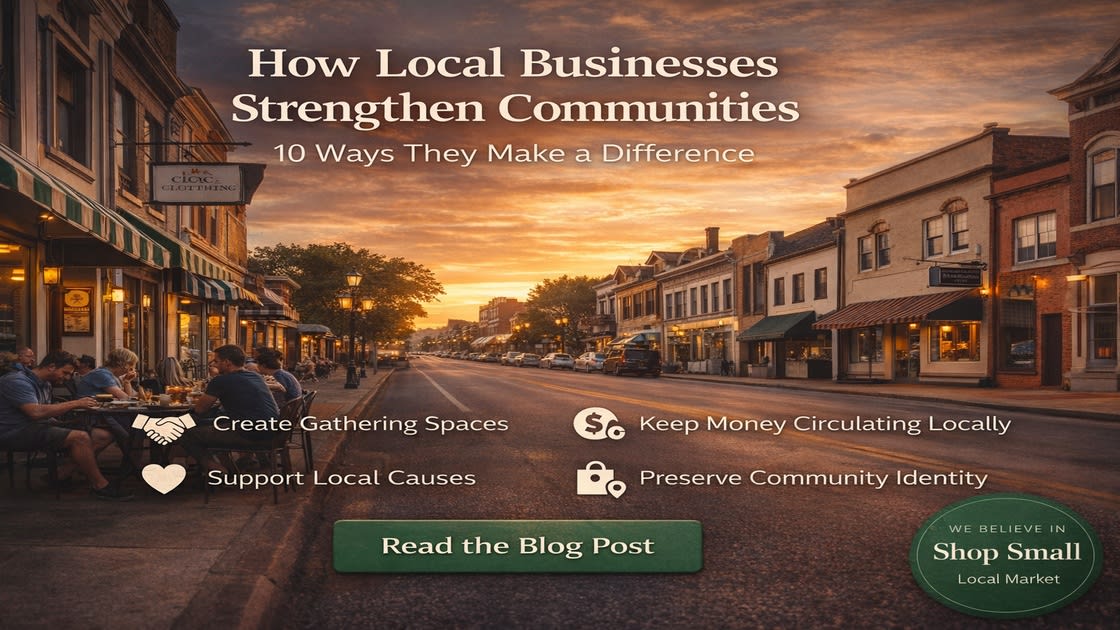
Walk down the main street of any thriving small town, and you'll feel it—a sense of place, connection, and community that big box stores and strip malls simply can't replicate.
That feeling isn't accidental. It's created by local businesses and the people who run them.
Local businesses don't just sell products and services. They strengthen communities in ways that are often invisible but profoundly important.
1. They Create Gathering Spaces
Every community needs "third places"—spaces that aren't home or work where people naturally gather, connect, and build relationships.
Local businesses create these spaces:
• The coffee shop where regulars know each other by name
• The barbershop where neighborhood news travels
• The bookstore that hosts community events
• The restaurant where families celebrate milestones
When these spaces close, the community loses more than a business—it loses a piece of itself.
2. They Keep Money Circulating Locally
When you spend money at a locally owned business, that money doesn't leave town. It pays local employees, sources from local suppliers, and gets deposited at local banks.
This creates a "local multiplier effect" where each dollar generates additional economic activity as it moves through the community. Studies show that money spent locally circulates 3-5 times before leaving the community.
3. They Provide Personalized Employment
Local businesses employ neighbors, not anonymous workers in distant warehouses.
Accountability: When the boss lives in the community, they're more likely to treat employees fairly.
Opportunity: Local businesses often promote from within and provide paths to ownership.
Flexibility: Small businesses can accommodate individual circumstances in ways large corporations cannot.
4. They Support Local Causes
Studies show that small businesses donate to local nonprofits at rates 250% higher than large corporations.
Local business owners sponsor little league teams, donate to school fundraisers, contribute to food banks, and support community events. They do this because they're part of the community—not because a corporate social responsibility department approved a budget.
5. They Preserve Community Identity
What makes your town different from every other town?
Often, it's the local businesses. The historic diner that's been serving the same recipes for 50 years. The quirky antique shop with items you won't find anywhere else. The family hardware store where five generations have worked the counter.
When local businesses are replaced by chains, communities start looking identical. Something important is lost.
6. They Respond to Local Needs
Big corporations make decisions in distant headquarters based on data and shareholder interests. Local businesses make decisions based on what their neighbors need.
A local grocery store might stock specialty items for the immigrant community. A local hardware store might stay open late during a storm. A local restaurant might offer a community meal program.
7. They Build Trust and Social Capital
Trust is the foundation of healthy communities. Local businesses build it in ways chains cannot.
When you buy from a local business, you know who you're dealing with. You can look the owner in the eye. You can hold them accountable. You build a relationship over repeated interactions.
Communities with strong local business sectors show higher levels of civic engagement, voter participation, and neighbor-to-neighbor trust.
8. They Create Mentorship and Learning Opportunities
Local businesses are training grounds for the next generation.
Teenagers get first jobs that teach responsibility, customer service, and work ethic. Young adults learn trades and professional skills. Aspiring entrepreneurs see what it takes to run a business up close.
9. They Support Other Local Businesses
Local businesses buy from other local businesses, creating an ecosystem of mutual support.
The local restaurant sources from local farms. The local retailer uses a local accountant. The local service business refers customers to other local providers.
10. They Make Communities More Walkable and Livable
Local businesses tend to locate in existing commercial areas—downtowns, neighborhood shopping districts, historic main streets. They occupy existing buildings and integrate into existing communities.
This creates walkable, vibrant neighborhoods where residents can meet their needs without driving. It preserves historic buildings, reduces sprawl, and makes communities more environmentally sustainable.
Find and support local businesses at Local Marketplace.