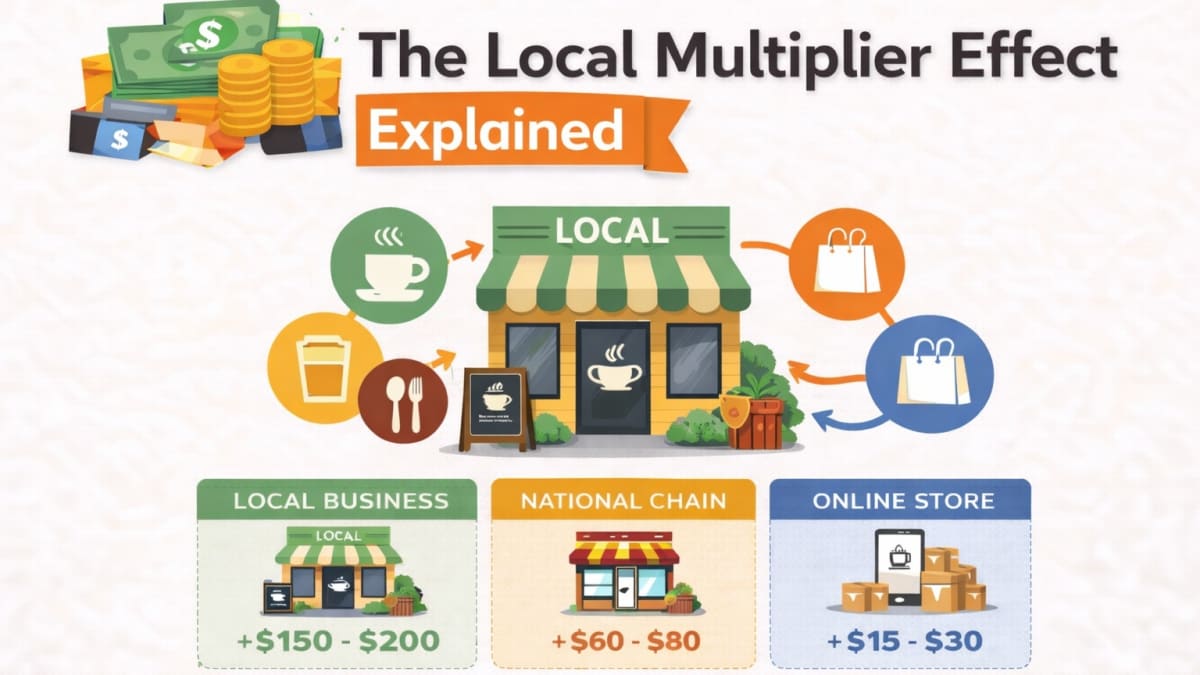
Ever wonder why economists and community advocates push so hard for shopping local?
It comes down to something called the "local multiplier effect"—a concept that explains how money spent locally doesn't just benefit one business, but ripples through the entire community, creating jobs, generating tax revenue, and building shared prosperity.
Understanding this effect changes how you think about every purchase you make.
The Basic Concept
The local multiplier effect is simple: money spent at local businesses circulates through the community multiple times before leaving.
When you spend $100 at a locally owned coffee shop:1. The shop pays its local baristas2. The baristas spend money at local restaurants and stores3. Those businesses pay their local employees4. Those employees spend at other local businesses5. And so on...
Each circulation generates economic activity—wages, profits, taxes—that benefits the community. Economists estimate that money spent locally can circulate 3-5 times before leaving the community.
The Numbers
$100 spent at a locally owned business:
• ~$68 stays in the local economy (first circulation)
• That $68 generates additional local spending
• Total local economic impact: approximately $150-200
$100 spent at a national chain:
• ~$43 stays in the local economy
• Less recirculation (chain sources nationally, banks nationally)
• Total local economic impact: approximately $60-80
$100 spent online (Amazon, etc.):
• ~$10-20 stays local (delivery wages, minimal local operations)
• Almost no recirculation
• Total local economic impact: approximately $15-30
The same $100 can generate 5-10x more local economic activity depending on where you spend it.
Why Local Businesses Multiply More
What makes locally owned businesses so much better at keeping money circulating locally?
Local Ownership: Local business owners live in the community. Their profits stay local. Chain store profits flow to corporate headquarters.
Local Employment: Local businesses hire neighbors. Those employees spend their wages locally.
Local Sourcing: Local businesses are more likely to use local suppliers—local accountants, local marketing services, local wholesale.
Local Banking: Local business owners often use community banks and credit unions, keeping deposits local.
Measuring the Multiplier
Economists measure local multipliers differently depending on what they're tracking:
Income Multiplier: How much additional income is generated per dollar of initial spending
• Local businesses: 1.5-2.0x
• Chain businesses: 0.8-1.2x
The exact numbers vary by community and methodology, but the direction is always the same: local spending multiplies more than non-local spending.
What This Means for You
Understanding the local multiplier effect reframes how you think about spending:
Your purchases have ripple effects. The $5 coffee isn't just $5. It's $5 that becomes $8-10 of local economic activity.
Small shifts add up. If you spend $500/month on goods and services, shifting just 20% ($100) from chains to local businesses generates an additional $40-60 of local economic activity. Multiplied by 12 months and thousands of households, this transforms communities.
Find local businesses to support at Local Marketplace.