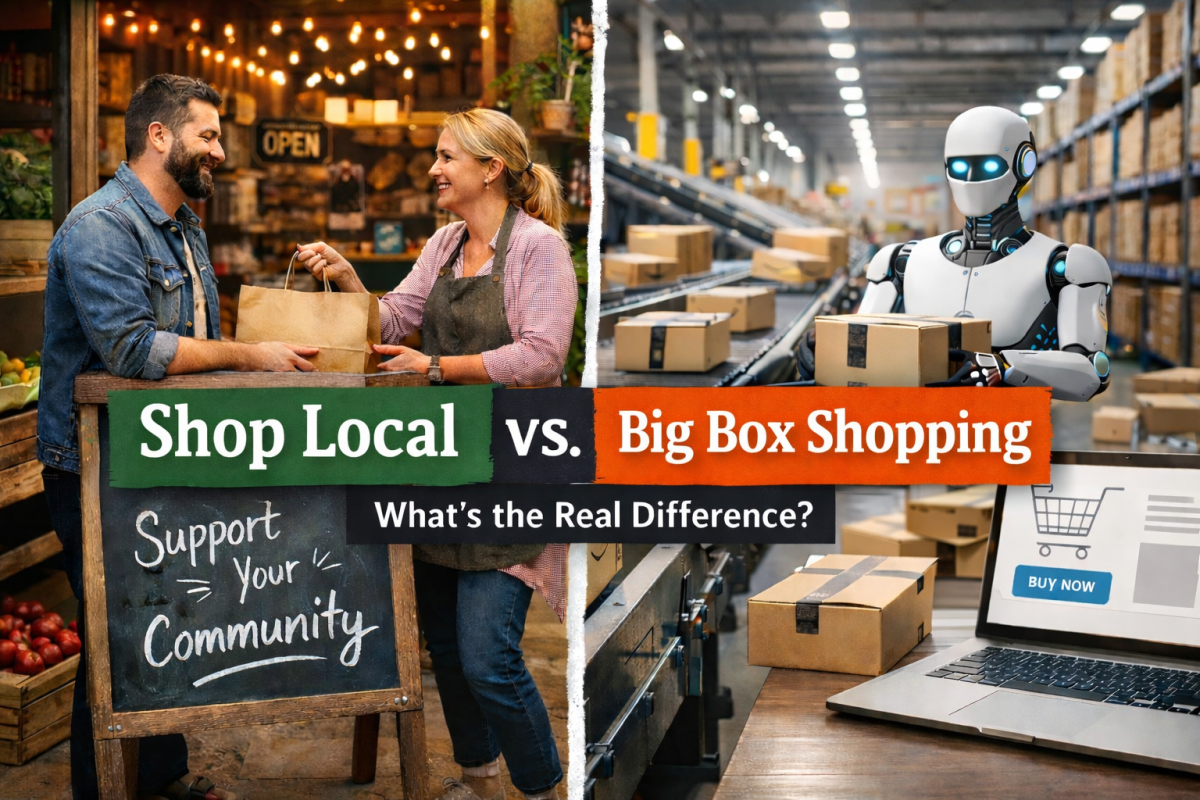
Let's be honest: Amazon is convenient. Two-day shipping, endless selection, competitive prices. It's hard to argue with that.
But every time you click "Buy Now," you're making a choice that extends beyond the transaction. You're choosing where your money goes, what kind of economy you support, and what your community looks like in ten years.
This isn't about guilt-tripping you into never using Amazon again. It's about understanding the real differences so you can make intentional choices that align with your values.
The Convenience Factor
Amazon wins on:
• Speed (same-day or two-day shipping)
• Selection (millions of products)
• Price comparison (easy to find deals)
• Ease (order from your couch in pajamas)
Local wins on:
• Immediate availability (walk out with your item today)
• No shipping (no waiting, no porch pirates)
• Touch and feel (try before you buy)
• Personal service (ask questions, get expert advice)
Where Your Money Goes
This is where the differences become significant.
Amazon Purchase ($100):
• ~$7-15 stays in your local economy (through delivery drivers and warehouse workers)
• Majority goes to: Seattle headquarters, global shareholders, international supply chains
• Local tax impact: Minimal
Local Business Purchase ($100):
• ~$68 stays in your local economy
• Money goes to: Local owner, local employees, local landlord, local suppliers
• Local tax impact: Property tax, sales tax, income tax—all benefiting local services
The math is stark. A $100 purchase at a local business generates roughly 4-5x more local economic activity than the same purchase from Amazon.
What You Lose When Local Businesses Close
Beyond economics, there are things Amazon simply can't replace:
Community gathering spaces. The coffee shop where everyone knows your name. The bookstore that hosts author events. The hardware store where the owner helps you solve problems.
Expert knowledge. The wine shop owner who knows exactly what you'll love. The toy store employee who can recommend age-appropriate gifts.
Local character. Every Amazon package looks the same. Local businesses give communities their unique identity.
Accountability. If a local business treats you poorly, you can talk to the owner. If Amazon treats you poorly, you talk to a chatbot.
When Amazon Makes Sense
Being honest about local shopping means acknowledging when Amazon is the right choice:
• Specialty items unavailable locally
• Accessibility needs (for people with mobility issues, delivery is essential)
• Rural areas without robust local retail options
• Price-sensitive necessities when budgets are truly tight
• Time-critical situations
The goal isn't perfection. It's intentionality.
A Practical Approach
Before clicking "Buy Now," ask:
1. Could I get this locally within a reasonable timeframe?
2. Would a local business have expertise that adds value?
3. Is this a gift or something meaningful where presentation matters?
4. Am I buying this on impulse (where friction is actually helpful)?
Set boundaries that work for you:
• "I'll always buy books from the local bookstore"
• "I'll check local options first for anything over $50"
• "Gifts always come from local shops"
Every purchase is a vote. What are you voting for?
Discover local alternatives at Local Marketplace.