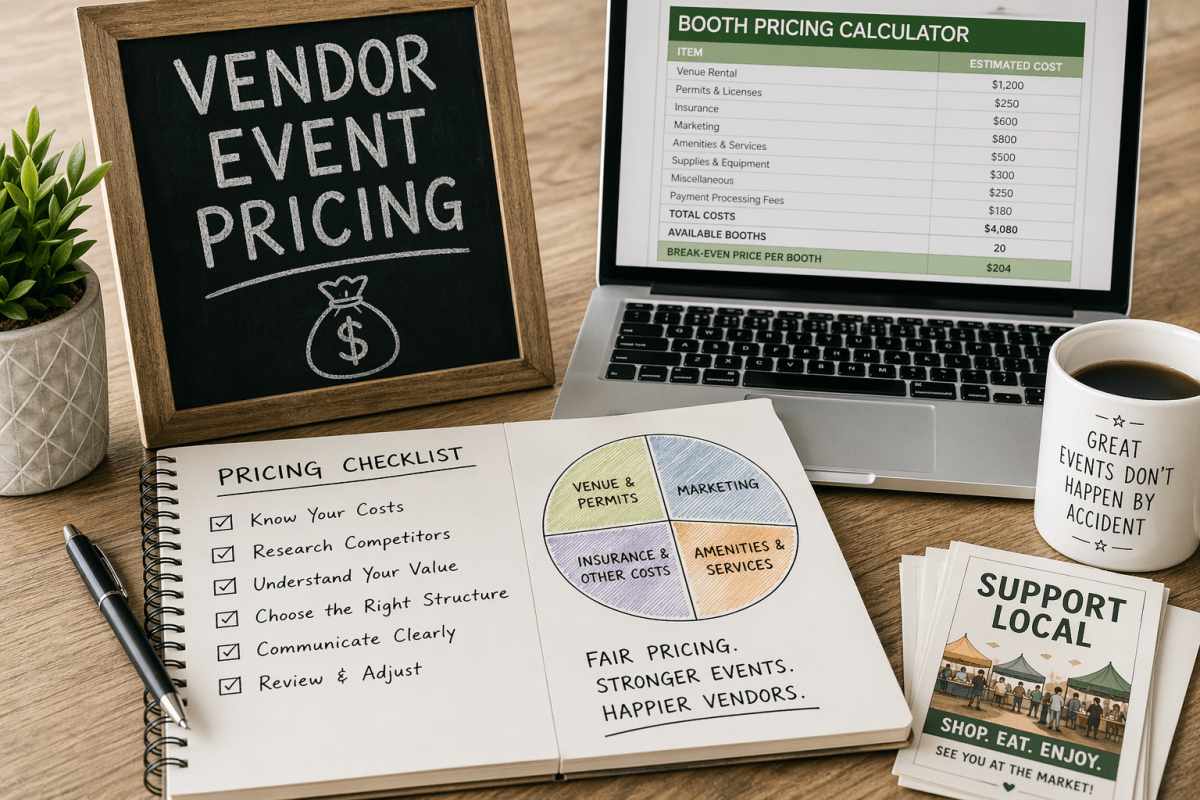
Booth fee pricing is one of the most consequential decisions a market organizer makes each season. Price too high and vendors won't apply. Price too low and the event loses money. Price without a clear rationale and vendors will question whether the market is worth their investment.
Despite how important booth fees are to both sides of the equation, most organizers set their prices based on gut instinct or whatever the market down the road charges. There's very little structured guidance available on how to think about booth pricing in a way that attracts quality vendors, covers costs, and positions the event for long-term growth.
This guide breaks down the factors that should go into booth fee pricing, the common mistakes that drive vendors away, and how to build a pricing structure that works for both organizers and the vendor community.
What Booth Fees Actually Need to Cover
Before setting a price, organizers need to understand exactly what their event costs to produce. Most organizers underestimate their true costs because they don't account for everything.
The obvious expenses include the venue or site rental, permits and licenses, insurance, portable restrooms, trash and recycling services, tables and tent rentals if provided, signage and banners, and marketing costs like social media ads, printed flyers, and directory listings.
The less obvious expenses include payment processing fees, website hosting and maintenance, communication tools, volunteer coordination, parking management, security or crowd control for larger events, electricity and generator costs for vendors who need power, and the organizer's own time. Time is the expense most organizers ignore entirely, but running a market is a significant commitment that should be factored into the financial model even if the organizer isn't paying themselves yet.
Once all costs are identified, the math becomes straightforward. Total event costs divided by the number of available vendor spots gives the breakeven price per booth. Everything above that number is margin that can be reinvested into improving the event, building reserves for weather cancellations, or compensating the organizer. Platforms like Local Market can reduce several of these costs by handling payment processing, vendor communication, and application management in one place — which directly affects how much organizers need to charge per booth.
How to Research What Other Markets Charge
Competitive research is an important input into pricing, but it shouldn't be the only input. Knowing what other markets in the area charge provides a baseline that vendors will use as a reference point whether the organizer likes it or not.
The best way to research is to look at markets that are similar in size, type, location, and audience. A small weekly farmers market in a rural town is not comparable to a large annual craft fair at a fairground. The right comparison is markets that compete for the same vendors.
Check the websites and application pages of 5 to 10 comparable markets within a reasonable driving distance. Note their booth fees, what's included in the fee (table, tent, electricity, or just the space), whether they charge different rates for different booth sizes or vendor categories, and whether they offer early bird pricing or multi-event discounts. Browsing verified events on Local Market is another quick way to see how similar markets in your region price their booths.
This research establishes a range. Pricing within that range is safe. Pricing significantly above it requires a clear justification that vendors can see and understand. Pricing below it raises questions about the quality and professionalism of the event.
Factors That Justify Higher Booth Fees
Not all markets are created equal, and vendors understand that. A market that charges more than the regional average can absolutely fill its vendor roster if the value justifies the price. The key is being transparent about what that value is.
High foot traffic is the most important factor. Vendors attend events to sell, and markets that consistently draw large crowds command premium pricing because vendors make more money there. If attendance data is available, share it. Saying "we averaged 3,000 visitors per market day last season" gives vendors a concrete reason to pay more.
Marketing investment matters. Markets that actively promote their events through paid advertising, email newsletters, local press coverage, and social media reach bring more shoppers, which means more sales for vendors. An organizer who spends $2,000 on Facebook ads to drive attendance is delivering real value that a market with zero marketing budget is not.
Location and accessibility play a role. Events in high-visibility, high-traffic locations with easy parking and good signage will naturally draw more walk-in shoppers than events tucked away in hard-to-find locations. A premium location justifies a premium price.
Reputation and track record matter significantly. Markets with years of history, loyal shopper communities, press coverage, and strong vendor satisfaction have earned the right to charge more. Newer markets without that track record need to price more competitively until they've built it.
Included amenities affect perceived value. Markets that provide tents, tables, chairs, electricity, Wi-Fi, and on-site support are offering more than markets that provide an empty grass patch. If the fee includes meaningful amenities, vendors will pay more because they're saving time and money on their own setup.
Factors That Require Lower Booth Fees
Certain conditions make it necessary to price below the regional average, at least temporarily.
New events without a track record need to price low enough to attract vendors who are taking a risk on an unproven market. First-year events often price 20 to 40 percent below established competitors to build their initial vendor roster. This isn't undervaluing the event — it's acknowledging that vendors are investing their time and inventory in something that hasn't proven itself yet. Raising prices after a successful first season is both expected and accepted by most vendors.
Events with lower expected foot traffic should price accordingly. A small neighborhood market that draws 200 visitors is not comparable to a regional fair that draws 5,000. Vendors calibrate their expected sales against the booth fee, and if the math doesn't work, they won't apply regardless of how nice the event is.
Markets in areas with high vendor competition may need to price lower to attract quality vendors who have many options. If there are three farmers markets within a 20-minute drive all happening on the same Saturday, the one with the weakest value proposition needs to compete on price or offer something the others don't.
Weather-vulnerable outdoor events carry more risk for vendors. A market with no rain-or-shine policy, no covered areas, and a history of weather cancellations should account for that risk in pricing. Vendors who've lost money to rained-out events will be reluctant to pay full price for another weather-dependent market.
Pricing Structures That Work
The simplest pricing structure is a flat fee for all vendors. One price, one booth size, no complexity. This works well for smaller markets with uniform booth spaces and a relatively homogeneous vendor mix. The advantage is simplicity — both for the organizer to administer and for vendors to understand.
Tiered pricing by booth size is the most common structure for mid-size and larger events. A standard 10x10 space costs one price, a 10x20 costs more, and corner or end-cap spots may carry a premium. This structure feels fair to vendors because they're paying for the amount of space they're using.
Category-based pricing charges different rates for different vendor types. Food vendors who need electricity, water access, and health permits might pay more than a jewelry maker who needs a table and a canopy. This structure makes sense when different vendor categories genuinely cost the organizer different amounts to accommodate, but it can create tension if vendors feel the pricing differences are arbitrary.
Early bird pricing offers a discount for vendors who apply and pay before a certain deadline. This is one of the most effective pricing tools available because it incentivizes early commitment, helps organizers plan, and gives vendors a tangible reward for acting quickly. A typical early bird discount is 10 to 15 percent off the standard rate, with a deadline 30 to 60 days before the event.
Multi-event discounts reward vendors who commit to multiple dates in a market's season. A vendor who signs up for all 12 weeks of a summer market might get a 15 to 20 percent discount compared to the single-week rate. This structure builds vendor loyalty, reduces the organizer's workload of filling spots each week, and gives vendors a meaningful cost savings for their commitment.
Day-of or last-minute pricing is worth considering for markets that consistently have unfilled spots. Offering remaining spaces at a discount on the day of or the week before the event fills gaps that would otherwise generate zero revenue. The discount should be meaningful enough to attract vendors who weren't planning to attend, but not so large that it discourages advance registration.
Common Pricing Mistakes
The most common mistake is pricing based solely on what competitors charge without understanding the event's own cost structure and value proposition. Copying a competitor's price without offering the same value leads to vendor dissatisfaction. Charging less than competitors while offering more leads to leaving money on the table.
Another frequent mistake is never raising prices. Events that charge the same booth fee for five or ten years are almost certainly underpricing, especially as costs for insurance, permits, and marketing have risen steadily. Vendors expect modest annual increases of 3 to 5 percent. What they don't expect or appreciate is a sudden 30 percent increase after years of flat pricing.
Hiding fees is a mistake that erodes trust quickly. If the listed booth fee is $100 but vendors discover a $25 application fee, a $15 processing fee, and a $30 electricity surcharge during checkout, the effective price is $170 and vendors feel misled. Transparent all-inclusive pricing, or at minimum a clear breakdown of all costs upfront, builds trust and reduces application abandonment. This is one reason why verified markets on Local Market are required to display their full pricing upfront — vendors can see exactly what they're paying before they apply.
Charging non-refundable application fees regardless of acceptance is another sore point for vendors. While organizers have legitimate reasons for charging application fees (they cover the time spent reviewing applications), vendors who pay $25 to apply, get rejected, and never see that money again will not apply to that market next year. A better approach is to waive the application fee or credit it toward the booth fee upon acceptance.
Failing to communicate value is perhaps the biggest mistake of all. A $200 booth fee with no explanation feels expensive. A $200 booth fee with a clear breakdown — "your fee covers venue rental, insurance, marketing that reaches 15,000 local shoppers, on-site parking management, and a 10x10 covered space with electricity" — feels reasonable. Vendors are willing to pay fair prices when they understand what they're getting.
How to Communicate Pricing to Vendors
Pricing should be visible and easy to find. Burying booth fees deep in an application form or requiring vendors to email for pricing creates unnecessary friction. The best practice is to list all pricing clearly on the event's website, application page, and any promotional materials directed at vendors. Markets listed on platforms like Local Market benefit from a standardized listing format that puts pricing, dates, and vendor categories front and center — making it easy for vendors to evaluate the opportunity before applying.
A pricing breakdown that shows what's included is more effective than a single number. Even a brief list — "your booth fee includes: 10x10 space, one 6-foot table, access to electricity, inclusion in our shopper marketing, and listing on our website" — demonstrates value and justifies the cost.
For markets that are raising prices, advance notice and an explanation make the difference between vendors accepting the increase and vendors leaving. Communicating price increases at least 60 days before the application period opens, along with a brief explanation of why (increased insurance costs, expanded marketing budget, venue improvements), gives vendors time to adjust and shows respect for their financial planning.
Testimonials from vendors who've had successful sales at the market are the most powerful pricing justification available. A vendor who says "I made $3,000 in sales at this market last year on a $150 booth fee" gives prospective vendors exactly the data they need to evaluate whether the fee is worth it.
Building a Pricing Strategy for Long-Term Growth
The best pricing strategies aren't static — they evolve as the market grows. A first-year event that charges below market rate to attract vendors, then gradually increases prices as attendance grows and reputation builds, is following a smart trajectory.
The goal over time is to reach a price point where booth fees fully cover event costs, provide a reasonable margin for the organizer, and still represent a strong return on investment for vendors. This balance is different for every market, but the principle is universal: vendors should feel like they're making money, and organizers should feel like the event is sustainable.
Collecting vendor feedback on pricing is one of the most underused tools available. A simple post-event survey that asks "was the booth fee fair for the sales you made?" provides direct insight into whether pricing is aligned with vendor expectations. Markets that consistently hear "yes" are priced right. Markets that hear "too expensive for what I sold" need to either lower prices or increase the value they deliver through better marketing and higher attendance. Market management platforms like Local Market's Market Masters portal make it easy to collect and track this kind of vendor feedback over time.
Ultimately, booth fee pricing is a reflection of the market's overall health. Events that invest in marketing, draw strong crowds, curate quality vendors, and run professionally can charge premium prices because the value is evident. Events that don't invest in these areas will struggle to justify even modest fees. The booth fee isn't just a number — it's a signal to vendors about how seriously the organizer takes the event and how much they've invested in making it successful.
Looking for a platform to manage your vendor applications and booth fees? Local Market gives market organizers a complete toolkit to list events, accept applications, collect payments, and connect with a growing community of verified vendors. Become a Market Master today →
Already a vendor looking for verified events to apply to? Browse verified vendor events on Local Market →