Think your individual purchases don't make a difference? Think again.
Every time you choose a local business over a national chain, you're making a decision that ripples through your entire community. The economic benefits of shopping local aren't just talking points—they're backed by hard data.
In this post, we'll break down the real numbers behind local spending and show you why economists, city planners, and community advocates all agree: shopping local is one of the most powerful things you can do for your community's economic health.
The Local Dollar: Where Your Money Actually Goes
The 68% vs. 43% Rule
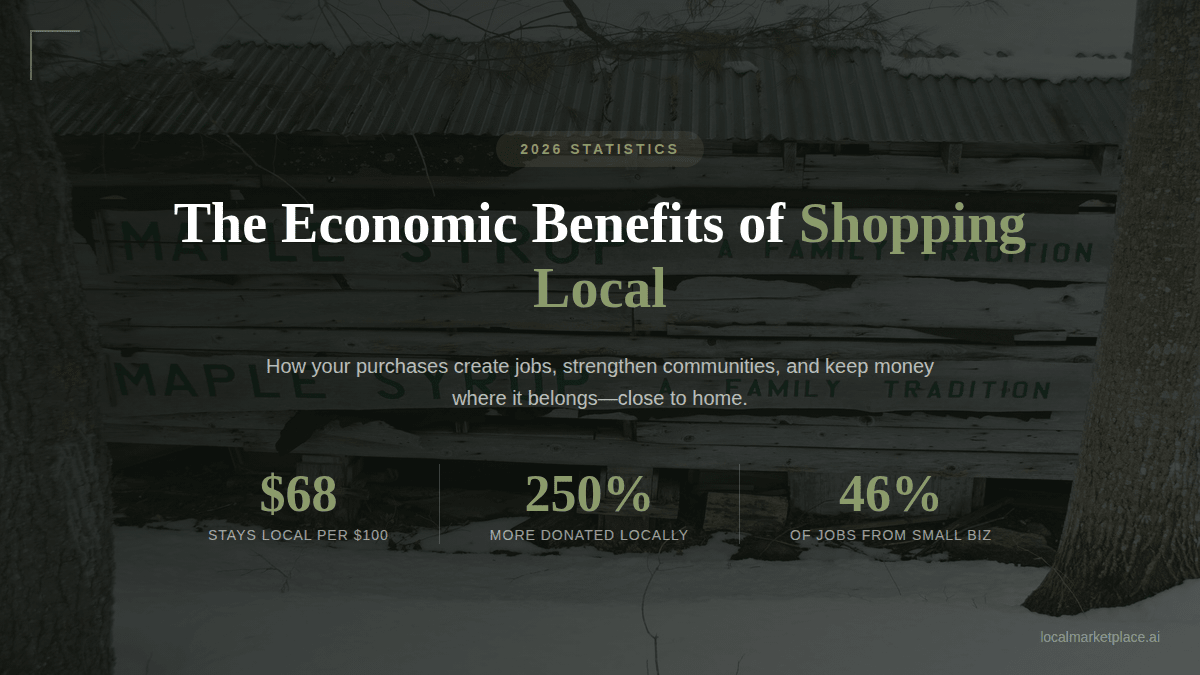
When you spend $100 at a locally owned business, approximately $68 stays in your local economy. That same $100 spent at a national chain? Only $43 stays local.
That's a 58% greater local economic impact from a single purchase.
Where does that extra money go? Local business owners pay local employees, rent local commercial space, use local accountants and lawyers, source from local suppliers, and deposit in local banks.
The Multiplier Effect in Action
Economists call this the "local multiplier effect." A dollar spent locally doesn't just benefit one business—it circulates through the community multiple times before leaving.
Here's how it works:
1. You buy coffee from a local roaster
2. The roaster pays their local barista
3. The barista buys lunch at a local sandwich shop
4. The sandwich shop orders bread from a local bakery
5. The bakery sources flour from a regional mill
Studies suggest that money spent locally can circulate 3-5 times before leaving the community.
15 Statistics That Prove the Economic Benefits
Job Creation
1. Small businesses employ 46.4% of the private workforce
2. Small businesses created 12.9 million net new jobs over the past 25 years
3. Local retailers create 2x more jobs per square foot than big box stores
Economic Impact
4. For every $100 spent at local businesses, $68 stays in the community
5. Independent retailers return 3x more money to the local economy than chains
6. Local businesses generate 70% more local economic activity per square foot
7. Shifting just 10% of spending to local businesses creates thousands of jobs
Tax Revenue
8. Local businesses generate more tax revenue per sales dollar
9. Property taxes from local business districts fund schools and infrastructure
10. Sales tax from local purchases stays in your community
Business Ecosystem
11. Local businesses buy from other local businesses
12. 99.9% of all U.S. businesses are small businesses
13. Small businesses account for 43.5% of U.S. GDP
Community Investment
14. Small businesses donate 250% more to local nonprofits than large businesses
15. Communities with strong local business sectors have higher property values
Making Your Money Work Harder
You don't have to change everything overnight. But understanding the economic impact of your choices empowers you to make them intentionally.
Consider this: if you spend $100 per week on goods and services, that's $5,200 per year. If you shifted just 25% of that spending to local businesses, you'd redirect $1,300 annually to your local economy—keeping approximately $884 in your community instead of $559.
That's $325 more per person, per year, staying local. Multiply that by thousands of households, and the impact becomes transformative.
Ready to find local businesses in your area? Explore Local Marketplace and start making your money work harder for your community.