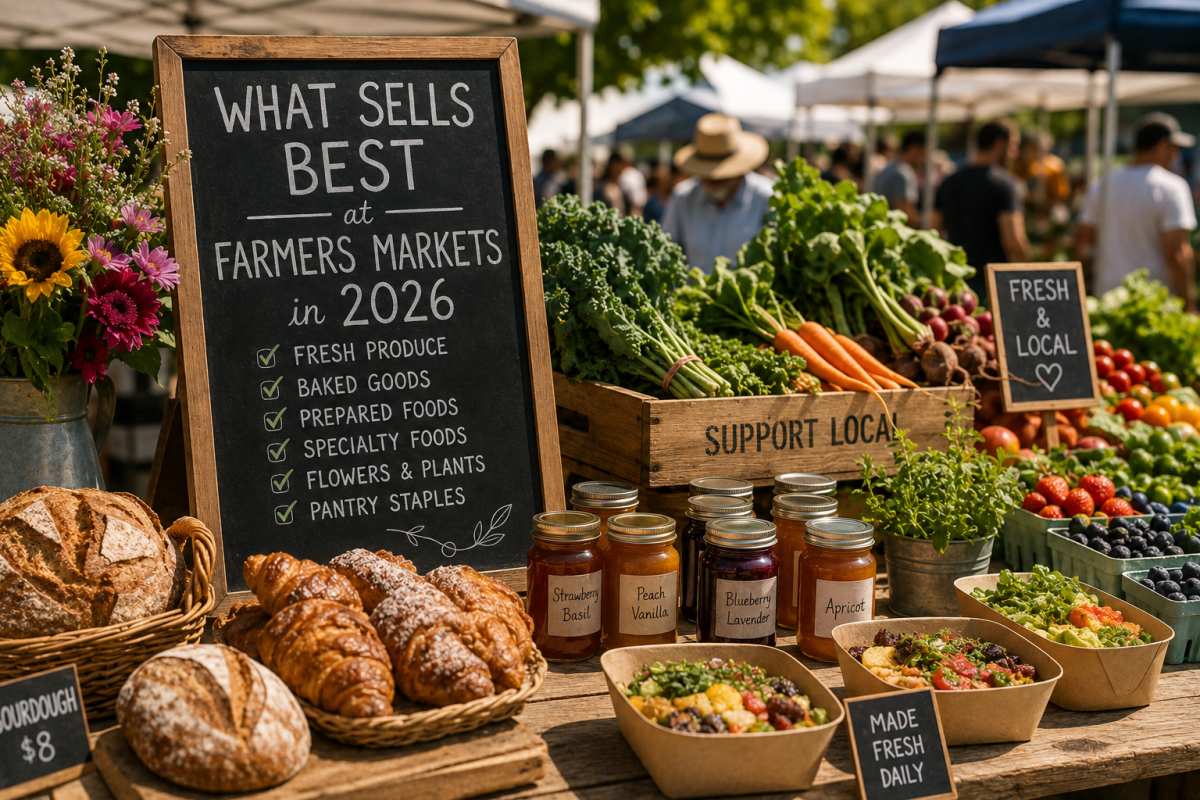
If you're trying to figure out what to sell at farmers markets this year, the honest answer isn't "whatever you make best." It's whatever has margin, demand, and shelf life, and those three things change every season.
The mistake most new vendors make is picking a product because they love making it, then wondering why they're not breaking even. The vendors who actually pay rent off market income picked their product the other way around: they figured out what sells, what's saturated, and what has room for a new entrant in their region, then they got into making it.
This guide walks through what's actually moving at farmers markets in 2026, what's gotten too crowded, and a framework for picking what's worth your booth.
What Hasn't Changed: The Boring Categories That Pay the Bills
Three categories have been the top sellers at farmers markets for the last decade, and 2026 is no different.
1. Fresh Produce — Still #1
In-season produce is still the highest-velocity category at almost every farmers market in North America. Tomatoes, berries, leafy greens, sweet corn, peppers — these are the products that bring foot traffic through the market, which means every other vendor benefits from the produce stand pulling people in.
What sells best within produce: heirloom and specialty varieties (purple carrots, lemon cucumbers, sungold tomatoes) out-margin commodity produce 2-3x at the same volume. Pre-bagged salad mixes and herb bundles add 40-60% margin over selling loose. And "ugly" or seconds bins for jam-makers and home preservers move what would otherwise be a loss.
The margin reality is that commodity produce competes with grocery stores and is brutal. Specialty produce competes only with other farms within about 50 miles. Pick that lane.
2. Baked Goods — Sourdough Is Still Selling
The 2020 sourdough boom never really ended. Five years later, sourdough is the single most consistently demanded baked good at markets — partly because it's a category most people associate with farmers markets specifically, not grocery store bakeries.
What works in 2026: naturally-leavened breads (sourdough boules, batards, country loaves) at $8-12 still move. Laminated pastries like croissants and danishes are high margin, Instagrammable, and sell out by 11 AM. Gluten-free baked goods done well have significant dollar density if you can actually make a non-gummy product. And single-serving items like cookies, bars, and individual pies are impulse buys at $4-6 that add up fast.
What's saturated: generic cupcakes, basic brownies, and standard chocolate chip cookies. Don't be the third cookie vendor at your market unless you have a real differentiator.
3. Eggs, Dairy, and Meat — Repeat Customers
These categories don't produce huge weekly volume, but they produce recurring weekly volume. Customers who buy your eggs once will likely buy them every week for two years. That repeat behavior is rare in handmade goods.
Reality check: all three categories are heavily regulated. Eggs need state-specific licensing, dairy requires significant facility investment, and meat usually requires USDA-inspected processing. Don't get into these casually.
What's Growing: The Categories With Momentum in 2026
This is where the real opportunity is — categories where demand is rising faster than supply.
Prepared Foods (Hand Pies, Dumplings, Tacos, Grain Bowls)
The single fastest-growing category at farmers markets right now. Customers come to markets hungry, and prepared-food vendors capture both the "I'm here, feed me" trade and the "take home for dinner" trade.
What's working: hand pies, empanadas, samosas, and pasties are portable and need no plates. Dumplings — gyoza, pierogi, modak — sell out everywhere. Korean and Mexican-American flavors are huge right now: kimchi everything, birria-adjacent products, gochujang sauces. Grain bowls and prepared salads appeal to the lunch crowd. And drink categories are exploding — cold-brewed coffee, kombucha on tap, and fresh juices.
Regulatory note: prepared foods often require a cottage food license or a commercial kitchen. Check your state's rules before investing.
Specialty and Cultural Foods
Customers want flavor they can't get at Whole Foods. In 2026, the categories with the most pull are Filipino, Vietnamese, Ethiopian, and Levantine flavor profiles — calamansi, fish sauce caramels, berbere spice blends, za'atar. Tinned and preserved seafood is having a moment — anchovies, sardines, mussels in olive oil. And functional foods like adaptogenic chocolates, mushroom-infused drinks, and fermented anything continue to grow.
The pitch that works: "You can't find this at the grocery store, and the person who made it is standing here."
Hot Sauce, Condiments, and Pantry Goods
Margins are excellent (often 70%+), shelf life is long, and the category has cult buyers who collect new sauces the way some people collect wine.
What's working: single-origin hot sauces (one specific pepper, one specific region), specialty mustards and aiolis, compound butters and finishing salts, and infused honeys (chili, lavender, smoked).
The math: a $10 hot sauce that costs $2 to make and lasts 12 months on a shelf is the highest-margin category most vendors will encounter. Stocking up for the season is a one-time effort.
Cut Flowers and Seasonal Bouquets
Bouquets have quietly become one of the highest-velocity impulse purchases at markets. Vendors who bring 50 bouquets often sell out by noon. The 2026 trend is "wild and asymmetric" rather than tight grocery-store roses.
What's selling: dahlia-focused bouquets in late summer, foraged and grasses-heavy arrangements at $25-40 each, single-stem dahlia "you pick" displays that are interactive and photo-worthy, and bouquet subscriptions sold at the market for weekly pickup.
Plants, Seedlings, and Herbs
Spring and early summer winner. Customers who garden are willing to spend $5-15 per starter plant, and they remember which booth gave them the tomato variety that worked.
What sells: tomato varieties (especially heirloom and cherry), peppers, basil, mint, lavender, succulents, and hanging baskets.
Pet Treats
The pet treat category has been growing steadily year-over-year and is still climbing in 2026. The vendors making this work are clear about ingredients (single-protein, no grain, freeze-dried) and pricing per-treat or per-bag.
What's working: single-protein freeze-dried treats (beef liver, salmon), birthday and celebration treats (decorated cookies for dogs), and bulk training-treat bags at $15-20.
Handmade Body Care — If You Have a Real Angle
Saturated category overall, but specialized angles still work in 2026. Solid and refillable formats like shampoo bars and deodorant in glass jars with refill stations are growing. Specific-skin-condition products (eczema-targeted, fragrance-free for sensitive skin) carve out a niche. And hyper-local ingredients — beeswax from your beekeeper neighbor, lavender from your farm — tell a story that generic products can't.
Avoid: generic "lavender + honey + oats" soap. There are already four of those at every market.
What's Harder Than It Looks (Saturated or Declining)
Be honest with yourself before investing in these.
Generic candles. Every market has 3-5 candle vendors. Customers can buy a candle at any of 50 stores. Unless you have an extreme angle (specific scent profiles, ceramic vessels that double as planters, an actual story), candles are a slow sell at high inventory cost.
Wax melts. Same problem as candles, more saturated, lower price point.
Standard handmade jewelry. Beaded bracelets, wire-wrapped pendants, and stamped metal jewelry are crowded. Customers price-compare you against Etsy and find your prices high. Only works if you have a genuinely distinctive aesthetic.
"Vague" t-shirts and tote bags. Unless you have a strong local-specific design (your town's name, a regional inside joke, a recognizable landmark), generic graphic shirts move slowly.
Drink mixes and cocktail bitters without samples. Hard to sell a flavor product when customers can't taste it. The vendors who succeed here always have a tasting setup. Without that, conversion is brutal.
The Framework: How to Actually Pick What to Sell
Forget what you want to sell. Run your idea through these five filters.
1. Margin Per Hour of Work
Calculate your true cost (ingredients + packaging + labor + booth fee + permits divided by units sold) and divide gross revenue by hours worked. If you're not netting at least $25/hour on average market days, the product isn't viable. We broke this down in detail in our booth fee pricing guide — the same logic applies to product margins.
If you're new to all of this, our free Vendor Academy walks through pricing, booth setup, and finding events step by step.
2. Demonstrability at the Booth
Can a customer understand what they're buying in under 5 seconds? "Local honey" — yes. "Adaptogenic mushroom tincture for stress modulation" — needs a 90-second pitch. If you need a pitch, you need samples or a sign that does the pitching for you.
3. Shelf Life and Storage
A product that lasts 90 days lets you produce in batches. A product that lasts 24 hours forces you to make it every Friday night. Both can work — but the second one requires real lifestyle commitment.
4. Transport and Setup
Glass jars on a hot day in the back of an SUV is a problem. Cut flowers that need a bucket of cold water at all times is a problem. Pies that need refrigeration is a problem. Factor it in before you commit. A solid canopy with proper tent weights and the right display equipment make a huge difference in how smoothly your market day runs. Check out our vendor gear guide for recommendations on canopies, displays, and transport solutions.
5. Repeat-Customer Potential
Some products customers buy once a year. Others they buy weekly. Eggs, bread, coffee, flowers, prepared foods, and pet treats all have weekly-buy potential. Candles, art, and specialty home goods don't. If your booth depends on repeat buyers (most do), make sure your category supports that.
How Regional Matters
This is the part most "what to sell" articles skip: a category that's saturated in Brooklyn is wide open in rural Kentucky, and vice versa.
Before committing, walk three to five markets in your actual region. Count how many vendors are in each category. Note which booths have lines and which don't. Talk to a few customers about what they wish was there.
You'll usually find one or two gaps that aren't obvious from data. That's your category.
Where to Apply Once You've Picked Your Product
If you're new to selling at markets, two things to do this week:
First, read our guide on the 7 mistakes new vendors make at their first market — most of them are about pricing and presentation, not product.
Second, browse verified markets near you and start applying. The best summer markets fill their vendor lineups in March and April. The last spots usually go in May and June. There are still events with open applications for late summer and fall.
And if you're worried about getting scammed by fake event listings on social media (which has gotten genuinely bad in 2026), we covered exactly how to verify an event is real before you pay any booth fees. You can also use our free Scam Checker tool to evaluate any event in 60 seconds.
The vendors who do well at farmers markets aren't the ones who picked the trendy category. They're the ones who picked a category with real margin, made it noticeably better than the competition, and showed up to the same markets every week for a year.
Pick the product. Show up. The customers come back.