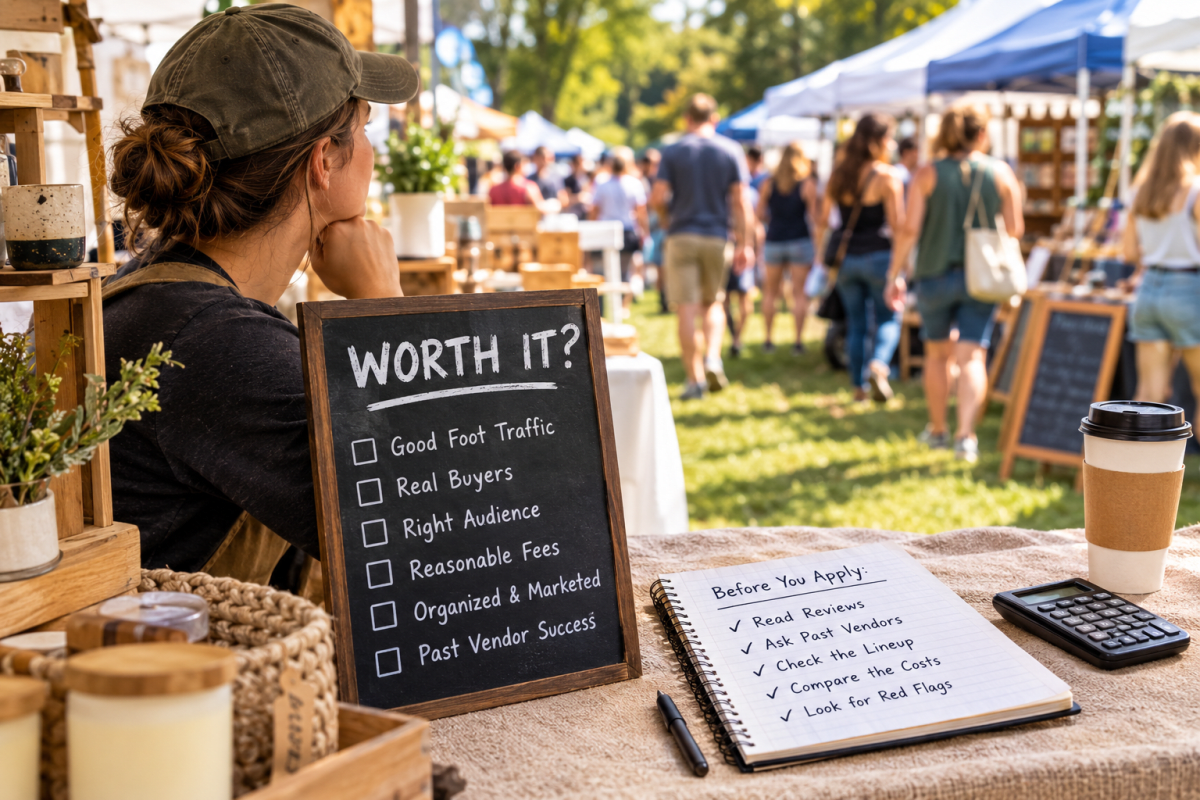
Before you send in another application and hand over a booth fee, it is worth asking a blunt question: is a craft fair worth it, or are you about to spend a weekend and a few hundred dollars just to break even? Not every show is a good show, and the polished photos on an event page tell you almost nothing about whether real buyers will walk up to your table. This guide breaks down how experienced vendors decide which craft fairs, art festivals, and markets are worth their time, so you can stop gambling on shows and start picking the ones that actually pay.
"Worth it" is not the same as "legit"
First, clear up a common mix-up. A show can be completely real and still be a bad use of your weekend. Confirming that an event is not a scam is a different question from whether it will make you money. If you are not yet sure an event is even legitimate, start with our guide on how to spot vendor event scams or run the show through the free vendor event scam checker. Once you know an event is real, the harder question begins: will it be worth the booth fee for someone selling what you sell?
The true cost of a bad show
The booth fee is only the sticker price. The real cost of a weekend show usually includes:
- The booth or application fee
- Gas, tolls, and sometimes a hotel
- Inventory you produced in advance
- Two or three days of your time, setup and teardown included
- The other show you turned down for that same weekend
Add it up and a "cheap" 75 dollar booth can easily represent 600 dollars or more in real cost once your time and travel are counted. That is why the goal is never just to cover the booth fee. It is to clear it several times over.
The signals that predict a good show
No single factor tells you whether a show will be worth it. Strong events tend to check most of these boxes at once.
1. The right kind of foot traffic
Big crowds are not the same as buyers. A festival that draws a hundred thousand people who came for the music and the beer garden can be worse for sales than a tight show of two thousand people who came specifically to buy handmade goods. Ask about attendance, but ask the better question too: do people come to this event to shop, and do they bring money to spend?
2. Sales other vendors actually made
The single best predictor of your sales is what other vendors took home. A maker who did the show last year can tell you more in two sentences than an event page tells you in two paragraphs. This is exactly why we built vendor reviews of markets and craft fairs, so you can see how a show rated on foot traffic, sales, venue, and day-of logistics before you pay a cent. When you can read what happened to real vendors at a specific event, the guessing mostly disappears.
3. Whether the audience buys what you sell
Fit matters as much as traffic. A 12 dollar soap maker and a 400 dollar oil painter can work the exact same show and have completely different days, because the crowd that buys impulse gifts is not always the crowd that buys big-ticket art. Look at the vendor lineup from past years. If makers at your price point and in your category keep coming back, that is a strong sign the audience is a match for what you make.
4. Booth fee versus realistic sales
Run a quick sanity check before you commit. Take the booth fee and divide it by the average price of your products. That is roughly how many items you need to sell just to break even. If a 150 dollar booth means you must sell 12 candles before you make a dollar, decide honestly whether this crowd will buy 12 candles from you, let alone enough to make the day worthwhile.
5. Vendor mix and saturation
Ten jewelry booths at a small show means ten makers splitting the same jewelry shoppers. A well-run event limits how many vendors it accepts in each category so nobody gets buried. If you cannot tell how many vendors share your category, ask the organizer directly. A good one will know and will tell you.
6. Organizer professionalism and marketing
An organizer who markets the event, answers questions clearly, and has a real plan for load-in and parking usually runs a show that draws buyers. An organizer who is vague, slow to respond, or only promotes the event in a single Facebook group is a warning sign. The quality of the organizer and the quality of the crowd tend to rise and fall together.
How to research a show before you apply
You can learn most of what you need in about twenty minutes:
- Read vendor reviews. Check what other vendors said about the event on foot traffic, sales, and logistics. Honest peer feedback beats any marketing copy.
- Ask past vendors directly. Look at last year's lineup, find a maker in a non-competing category, and send a friendly message asking how the show went for them.
- Look at the event's marketing. Is the organizer actively promoting the date, the lineup, and the location? Shoppers only show up if someone invited them.
- Check the track record. A show in its tenth year has survived because vendors keep coming back. A brand-new show with a high fee and no history is a bigger bet.
- Weigh the logistics. Indoor or outdoor, parking, load-in, power, and weather exposure all affect both your sales and your stress level.
A simple worth-it formula
Here is a rule of thumb many full-time vendors use. Figure out your break-even in units (booth fee divided by average product price), then aim for a show where you can realistically clear the booth fee three to five times over after costs. If a show only ever lets you break even, your time is better spent making product, applying to a stronger event, or selling online that weekend. Track your actual results at every show and you will quickly build a personal list of events that are worth it and events that are not.
Red flags a show is probably not worth it
- A high booth fee on a first-year event with no vendor track record
- No visible marketing beyond a single social post
- An organizer who will not answer basic questions about attendance or vendor count
- Your category is clearly oversaturated in the lineup
- Past vendors describe thin crowds, poor sales, or chaotic logistics
- The fee structure keeps growing (application fee, booth fee, electricity fee, corner fee) with little in return
After the show, keep score and help the next vendor
The vendors who consistently pick good shows are the ones who track their own numbers. Write down your sales, your costs, the weather, and how the crowd felt after every event. Over a season that becomes the most valuable data you own. And when a show is over, take two minutes to leave an honest review so the next maker does not have to guess. The more vendors who share real numbers, the harder it becomes for weak shows to keep charging for weekends that do not deliver. While you are planning your calendar, our guides on how to apply to vendor events and get accepted and setting up a booth that actually sells will help you get the most out of the good shows once you find them.
The bottom line
So, is a craft fair worth it? It is worth it when the crowd comes to buy, the audience fits what you make, the fee is reasonable against realistic sales, and the organizer runs a tight, well-marketed show. You do not have to find all of that out the hard way. Create a free vendor account on Local Market and browse vendor-reviewed events so you only spend your weekends on the shows that are genuinely worth your time.